What is Push in Blackjack: Complete Guide to Ties and Returns


Introduction
A push in blackjack occurs when both the player and dealer finish with identical hand totals, resulting in a tie where your original bet is returned. This outcome represents a neutral result—you neither win money nor lose your initial wager. Understanding push mechanics is essential for anyone who wants to play blackjack with realistic expectations about possible outcomes at blackjack tables.
This guide covers everything about push situations in blackjack games: the core mechanics behind tied hands, specific scenarios where pushes commonly occur, mathematical probabilities, and strategic implications for your bankroll. Whether you’re new to the game or refining your approach at multiple decks tables, this content addresses the full scope of push outcomes while excluding unrelated topics like advanced card counting techniques.
When a push occurs, your original wager stays in place or returns to you—the round ends without additional winnings or losses. In most blackjack games, this happens approximately 8.5% of the time under standard rules.
After reading this guide, you will gain:
- Clear understanding of push mechanics and when they apply
- Recognition of common push scenarios including natural blackjack ties
- Knowledge of exact bet return rules during tied hands
- Insight into push probabilities across different blackjack variations
- Strategic considerations for incorporating pushes into session planning
Understanding Push in Blackjack
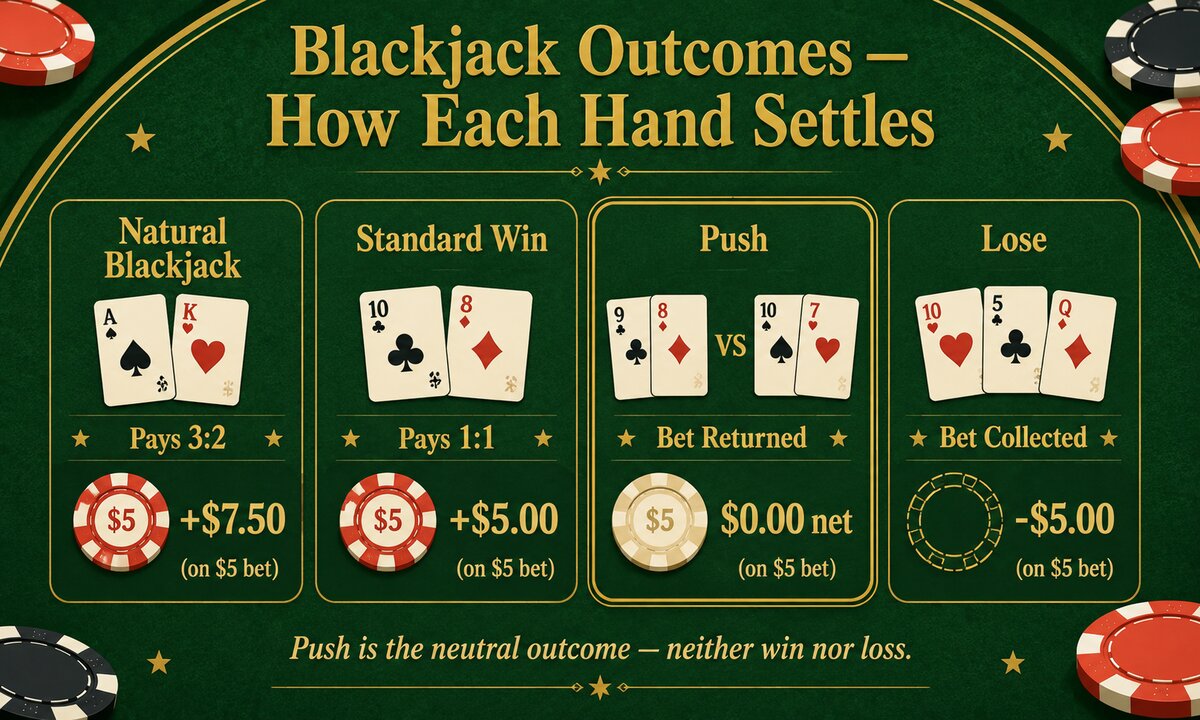
Push sits between win and loss — neutral net result.
A push represents the tie situation in blackjack where neither player nor dealer wins the hand. When both you and the dealer end with the same value total, the hand resolves as a standoff. Your initial bet neither grows nor disappears—it simply returns to you for the next round.
Basic Push Mechanics
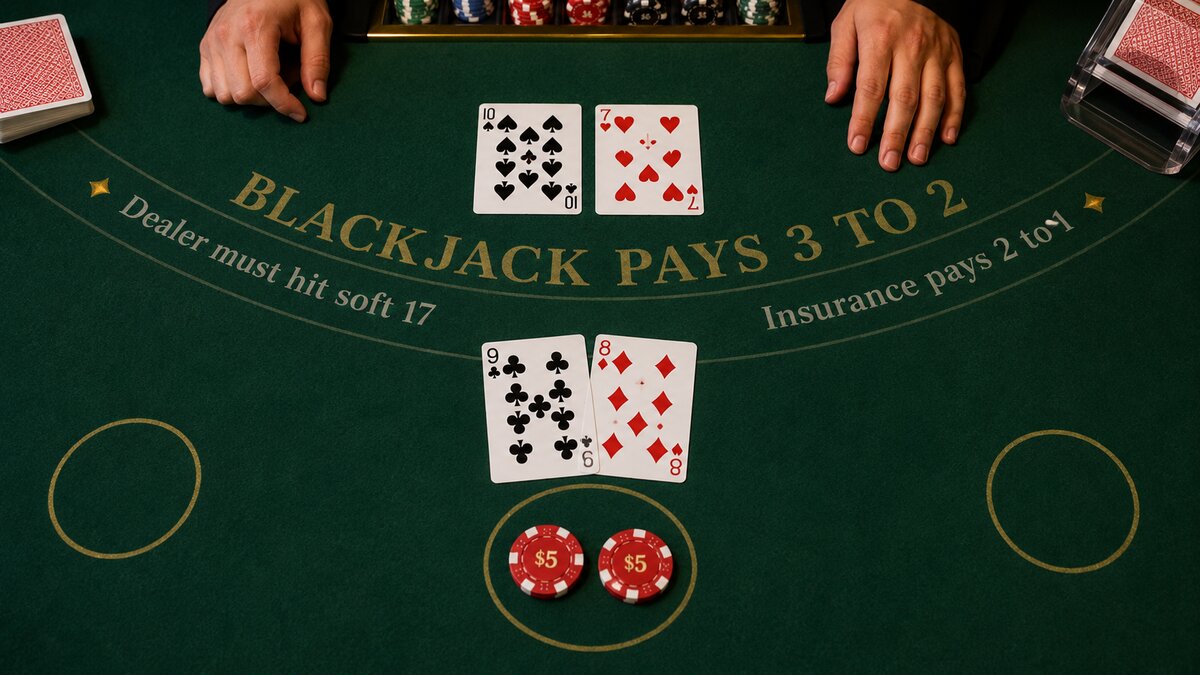
A push happens when identical hand values create tie conditions between player and dealer. For example, if your first two cards and subsequent draws bring you to 19, and the dealer’s hand also reaches exactly 19, the result is a push. The dealer pushes your bet back rather than collecting it or paying out.
This automatic bet return occurs without any action required from you. Once totals match and neither party has busted, the round concludes. Your original stake remains yours, ready for the next hand. This connects directly to blackjack’s core objective: beating the dealer without exceeding 21. When neither side achieves advantage, the push provides a neutral resolution.
Push vs Other Blackjack Outcomes
Pushes differ fundamentally from other blackjack results. When you win, your player’s bet receives a payout—typically 1:1 for standard wins or 3:2 for a natural blackjack. When the dealer wins, your bet is collected. When either party busts by exceeding 21, the outcome is immediate loss for whoever busted first.
The push occupies middle ground in the payout structure. While it doesn’t contribute to house edge calculations directly (you break even), pushes reduce the frequency of winning hands. In standard six-deck games, players win roughly 42% of hands, lose about 49%, and push approximately 8.5%. Understanding this distribution helps contextualize why pushes matter for realistic session expectations.
Knowing when pushes commonly occur helps you anticipate outcomes and manage your approach to each hand.
Common Push Scenarios in Blackjack
Most pushes happen on 17s, 18s, 19s, or 20s.
Building on push mechanics, specific situations create tied hands with predictable frequency. Recognizing these scenarios helps you understand outcomes before they happen and sets appropriate expectations at blackjack tables.
Natural Blackjack Pushes
The most notable push scenario involves both the player and dealer achieving natural blackjack—an ace valued at 11 plus a 10-value card dealt as the first two cards. When you’re dealt blackjack and the dealer reveals a matching 21 from their hole card, the result is an immediate push rather than your expected 3:2 bonus payouts.
This situation occurs when the dealer shows an ace face up or a 10-value card, and their face down hole card completes the natural. Statistically, natural blackjack pushes happen in approximately 0.23% of all hands—extremely rare but notable when they occur. The timing involves the dealer checks for blackjack before other players act, and if both you and the dealer have naturals, the hand resolves immediately as a tie.
Many players feel disappointed when their dealt blackjack converts to a push rather than a win. However, this outcome is preferable to losing and maintains your original bet for continued play.
Standard Value Pushes
Far more frequent than natural blackjack ties are pushes on standard hand values between 17 and 20. When both you and the dealer end with totals like 18, 19, or 20 through multiple cards, the hand results in a push.
Ties on 20 represent the most common push scenario in most games. Both parties frequently achieve this total—you might stand on a face card combination while dealer hits until reaching the same value. Pushes on 19 rank second in frequency, followed by 18 and 17.
House rules regarding when the dealer hits or stands significantly affect these outcomes. In games where dealer hits soft 17, the dealer may draw a third card more often, potentially changing final totals and push frequency. Conversely, when dealer stands on all 17s, certain push configurations become more predictable.
Special Push Rules
Several blackjack variants introduce modified push rules that substantially change gameplay. The most significant is the “Push 22” rule found in games like Blackjack Switch and Power Blackjack. Under this rule, when the dealer busts with exactly 22, instead of standard dealer busts outcomes where players win, all non-busted player hands push.
This rule dramatically shifts house edge—estimates suggest Push 22 adds approximately 0.5% advantage for the casino. Players accustomed to traditional blackjack rules may not realize this variation exists until experiencing unexpected pushes.
Side bets interact differently with main hand pushes. An insurance bet, for instance, is a separate additional bet on whether the dealer’s upcard (an ace) will pair with a 10-value hole card for blackjack. Insurance pays 2:1 if the dealer has blackjack but operates independently from whether your main hand pushes. Most side bets do not push—they typically lose unless specific conditions are met.
Some casinos offer “Push 22 Progressive” side bets where players wager specifically on the dealer reaching 22. Different rules apply at different venues, making it essential to understand specific house rules before playing.
The most frequent push scenarios involve matching totals on 19-20, with natural blackjack ties occurring rarely but memorably. These probabilities directly inform strategic considerations.
Push Probabilities and Strategic Implications
Understanding push frequency provides foundation for realistic session planning and bankroll expectations. Mathematical probabilities shape how often you’ll experience tied hands across different game conditions.
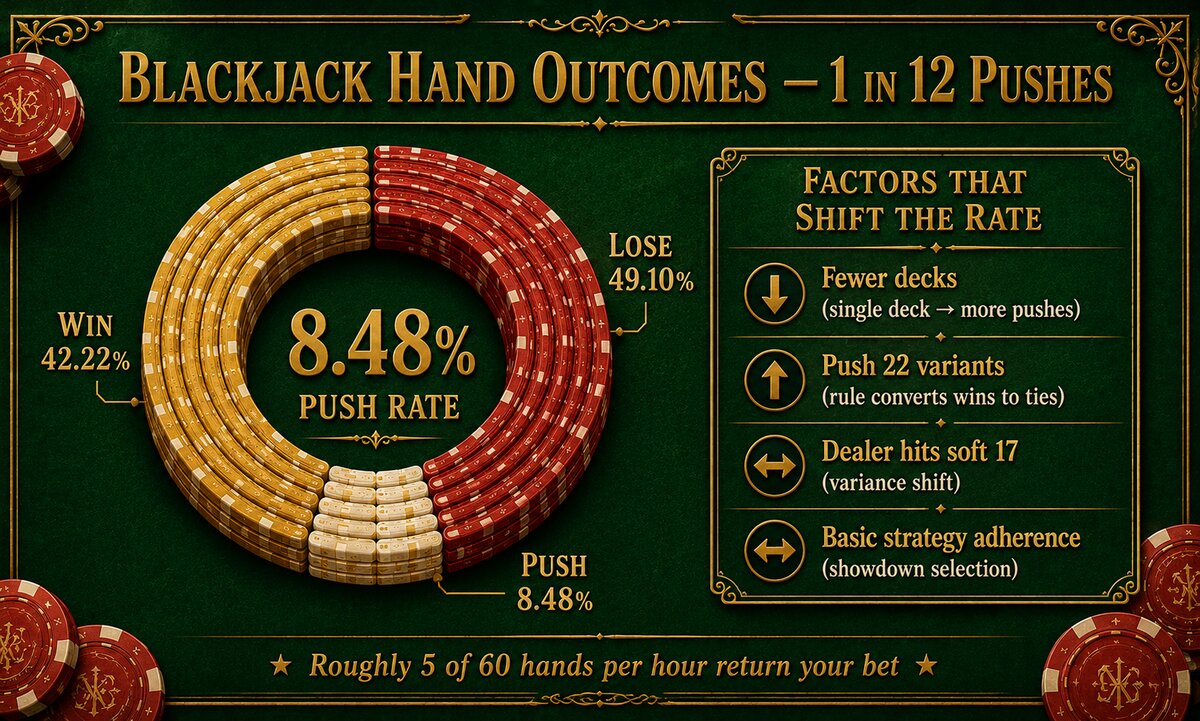
Pushes occur about 1 in every 12 blackjack hands.
Mathematical Probability of Pushes
In standard multi-deck blackjack with common rules (dealer stands on soft 17, blackjack pays 3:2), pushes occur in approximately 8.48% of all hands. This means roughly 1 in 12 hands results in your original wager returning unchanged.
Several factors affect push rates:
- Number of decks: Fewer decks slightly increase push probability because card removal effects make matching totals more likely. Single deck blackjack produces marginally more pushes than eight-deck games.
- Dealer standing rules: When dealer hits soft 17, variance increases and tie frequencies shift. The additional third card or subsequent draws create different final total distributions.
- Game variations: Rule variants like Push 22 dramatically alter expected push rates by converting what would normally be player wins into ties.
- Basic strategy adherence: Following optimal play influences which hands you take to showdown versus which you surrender or bust on, indirectly affecting your personal push frequency.
For comparison, standard probabilities break down approximately: wins 42.22%, losses 49.10%, pushes 8.48%. While losses exceed wins, the high probability of pushes provides variance buffer that moderates bankroll swings.
Push Impact on Bankroll Management
| Criterion | Standard Rules | Push 22 Variations |
|---|---|---|
| Session length | Neutral impact on duration | May extend play with more ties |
| Betting strategy | No adjustment needed | Consider higher variance |
| Expected value | Zero on individual pushes | Rule-dependent, typically worse |
| Bankroll volatility | Moderate buffer | Increased house edge |
Pushes create interesting bankroll dynamics. Since approximately 8.5% of hands produce zero change, betting systems must account for these neutral outcomes. Progressive betting strategies encounter longer sequences before resolution, as pushes extend the time between definitive wins and losses.
For session planning, pushes mean you’ll experience fewer decisive outcomes per hour than raw hand counts suggest. If you play 60 hands per hour, roughly 5 will push—55 hands actually affect your chip stack. This understanding helps set realistic win/loss expectations and stop-loss parameters.
Strategic decisions around even money and taking insurance revolve partly around push avoidance. When you have a blackjack hand and dealer shows an ace, accepting even money guarantees 1:1 payout instead of risking a push if the dealer also has natural blackjack. Basic strategy generally recommends declining even money because the expected value of waiting (potential 3:2 payout) exceeds the guaranteed 1:1, but individual risk tolerance varies.
Common Push Misunderstandings and Clarifications
Several misconceptions persist about push outcomes, particularly regarding how they interact with side bets and insurance options. Clearing up these confusions helps players make informed decisions.
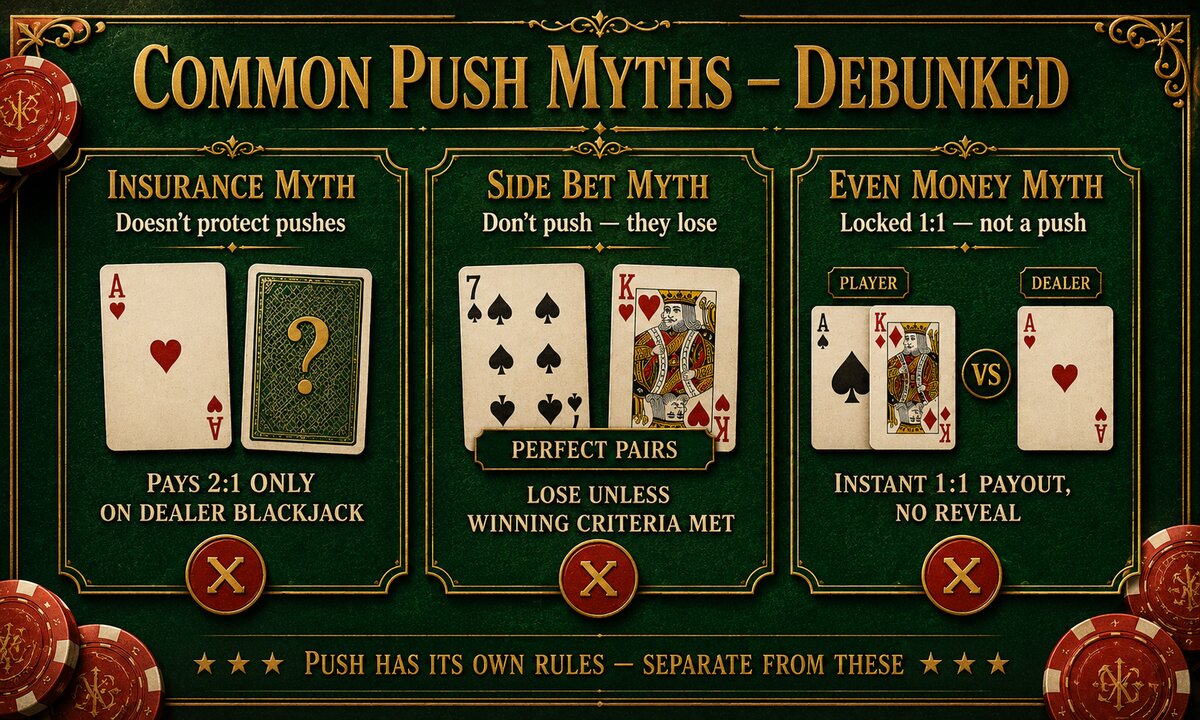
Insurance pays 2:1 only on dealer’s natural blackjack.
Push vs Insurance Confusion
A frequent misunderstanding treats the insurance bet as protection against pushes or losses in non-blackjack hands. This is incorrect. Insurance is strictly a side bet on whether the dealer’s card combination includes blackjack when dealer shows an ace as their upcard.
If you take insurance and the dealer reveals a natural blackjack, insurance pays 2:1. Your main hand outcome—whether it pushes with your own blackjack or loses outright—remains separate. Insurance doesn’t protect against standard value pushes or any losses where the dealer doesn’t have natural blackjack.
Treat insurance and push outcomes as completely distinct betting decisions. The insurance bet resolves based solely on the dealer’s hole card value, not on the relationship between your total and the dealer’s final hand.
Side Bet Push Misconceptions
Many players assume side bets push when conditions aren’t met. In reality, most side bets simply lose unless their specific winning criteria are achieved. If you place a Perfect Pairs side bet and don’t receive a pair, you lose that additional bet regardless of whether your main hand wins, loses, or pushes.
Some blackjack variations like Free Double or early surrender options interact with main hand outcomes but still don’t create side bet pushes. Always verify specific side bet rules at your table—casinos differ significantly in their offerings and payout structures.
Even Money vs Push Scenarios
Even money offers and natural blackjack pushes represent distinct concepts that players often conflate. When you have a natural blackjack and dealer shows an ace, many casinos offer “even money”—immediate 1:1 payout before the dealer checks their hole card.
Accepting even money guarantees profit but reduces potential winnings. If you decline and the dealer also has natural blackjack, your hand pushes and you receive only your original wager back—no bonus payouts. However, if the dealer doesn’t have blackjack (more likely outcome), you receive the full 3:2 payout.
Mathematically, declining even money produces higher expected value over many hands because the dealer has blackjack less often than not when showing an ace. However, individual decisions depend on session goals and risk tolerance. Neither choice is “wrong”—they represent different approaches to variance management.
Understanding these distinctions prevents costly confusion during actual play.
Conclusion and Next Steps
A push in blackjack is a neutral tie outcome where both you and the dealer finish with equal value totals, resulting in your bet returning unchanged. This happens in approximately 8.5% of hands under standard rules, providing a variance buffer that moderates bankroll swings without contributing to profit.
To apply this knowledge effectively:
- Recognize push scenarios before they resolve—matching totals between 17-21 and simultaneous natural blackjacks
- Understand that your original bet returns automatically; no action required
- Factor the ~8.5% push rate into session planning and realistic outcome expectations
- Verify house rules regarding Push 22 variants before sitting at unfamiliar blackjack tables
- Treat insurance bets as separate from push outcomes when making betting decisions
Related topics worth exploring include basic strategy optimization for reducing unfavorable outcomes, bankroll management techniques that account for push frequency, and evaluating blackjack variants with modified push rules to understand their impact on house edge.
Additional Resources
For deeper understanding of push-related probabilities:
- Basic strategy charts that display expected outcomes including push frequencies for various hand combinations
- Probability calculators comparing push rates across single deck blackjack versus multiple decks configurations
- Casino rule comparison tools highlighting venues with standard versus Push 22 variations
- Bankroll variance calculators incorporating push rates for session planning