How to Tell If a Slot Machine Is Going to Hit (The Honest Answer)

You cannot tell if a slot machine is going to hit. Every spin is decided by a random number generator the instant you press the button, so no machine is ever due. What you can do is pick better machines: higher RTP, the right volatility, and must-hit-by progressive jackpots close to their cap.
If you are reading this on your phone in front of a wall of machines, you are in good company. Most people searching this question are standing on a casino floor right now, trying to decide where to sit.
So here is exactly what this page covers: first, the truth about predicting slot machines, including the only two situations where a machine really can be worth more than the one next to it. Then, what measurably improves your machine choice. Finally, the popular signs and rituals that quietly drain bankrolls. Everything below is based on how regulated slots actually work, meaning certified RNG software and state gaming commission data, not casino folklore.
How Slot Machines Actually Decide When to Pay
Open up any regulated slot machine and you will not find luck inside. You will find a computer running a random number generator (RNG), a program that cycles through thousands of numbers every second, whether anyone is playing or not. The moment you press spin, the machine grabs whatever number exists at that exact instant and maps it to an outcome. The spinning reels are animation. Your result was settled before they started moving.
Each spin is also statistically independent. The machine keeps no memory of past wins or losses and has no idea how long it has been since the last jackpot. That single fact kills roughly 90 percent of the methods people use to tell when a machine will pay.
What is fixed is the long-run average. Every game’s payback is defined on a PAR sheet by the manufacturer, and it has to sit within state-regulated limits. Nevada’s Regulation 14 requires a theoretical return of at least 75 percent of all money wagered, and New Jersey sets its floor at 83 percent. Those settings shape averages across millions of spins. They say nothing about your next one.
Here is the reconciliation most articles never make: randomness means you cannot predict a machine, but math still lets you select a better one. Prediction is impossible. Selection is not. The rest of this page is about that difference, and it applies the same way whether you are on a Vegas floor or spinning online slots from your couch.
So Can You Ever Tell a Slot Machine Is About to Hit?
The straight answer is no, with two narrow exceptions. Both are math, not mind reading, and neither involves listening to the machine or reading its mood.
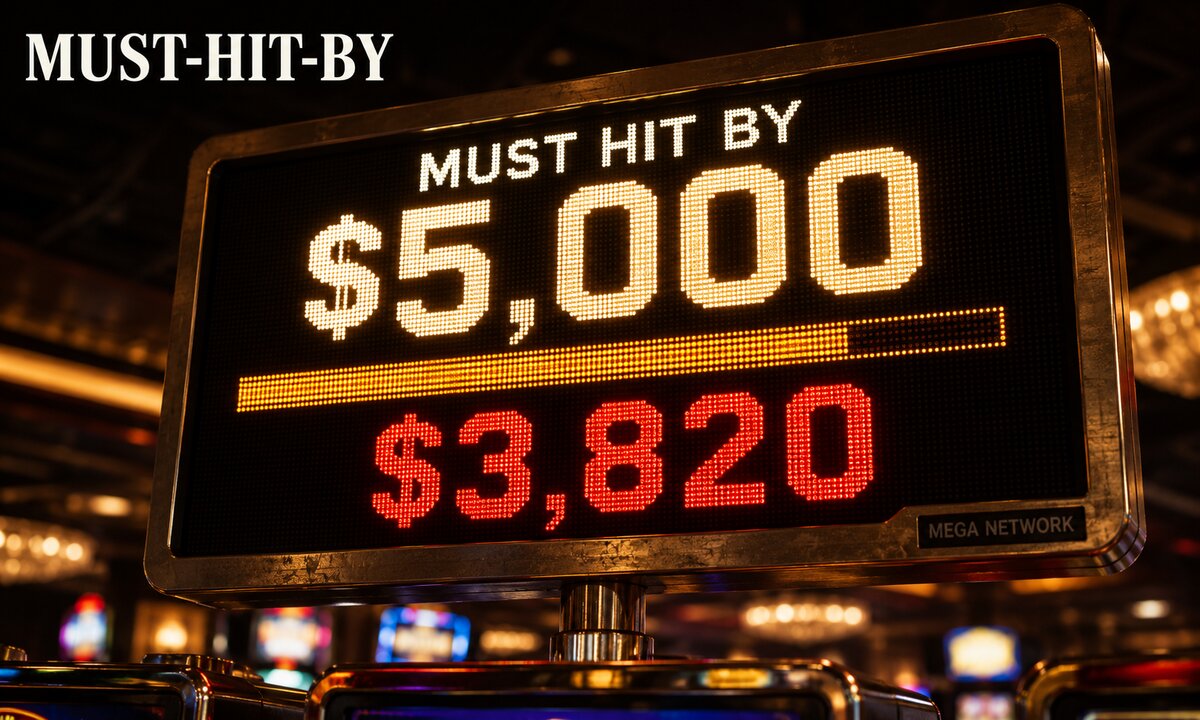
Jackpot forced before the cap.
Exception 1: Must-Hit-By Progressive Jackpots
Some progressive slots display a jackpot that is guaranteed to pay out before the meter reaches a posted cap, for example “must hit by $500.” This is the only legitimate sense in which a machine can be close to hitting. The jackpot is not due in time, but it is mathematically forced to land within a known amount of future wagering.
The closer the meter sits to its cap, the better your expected value, because less money can pass through the machine before someone wins. This is why advantage players walk casino floors scanning for meters at 90 percent or more of their cap and ignore the same game when the meter is low.
Two honest caveats. First, “better expected value” can still mean feeding the machine heavily before the jackpot lands, and the base game underneath is often tight. Second, you are not the only person who knows this. In busy casinos, near-cap meters get claimed fast.
Exception 2: Value Left Behind by Other Players
A growing number of games bank progress between spins: collected symbols, filling meters, accumulated mini-bonuses that persist even when a player walks away. If someone abandons a machine two coins short of triggering a feature, that progress does not reset. The next player inherits it.
These are called persistent-state games, and a machine abandoned mid-accumulation carries real leftover value. Common examples include games where you collect tokens toward a bonus wheel, fill a progress bar that upgrades the next free-spins round, or build a coin bank that eventually pays out. The catch is the same as above: local regulars hunt these states all day, so genuinely valuable abandonments are rarer than the strategy videos suggest.
Outside those two cases, every “sign” you have heard about, whether it is the sounds, the reel behavior, an attendant’s whisper, or the way the bonus teases, is noise. We will dismantle those one by one further down.
What the Machine Can Tell You: How to Read Any Slot in 60 Seconds
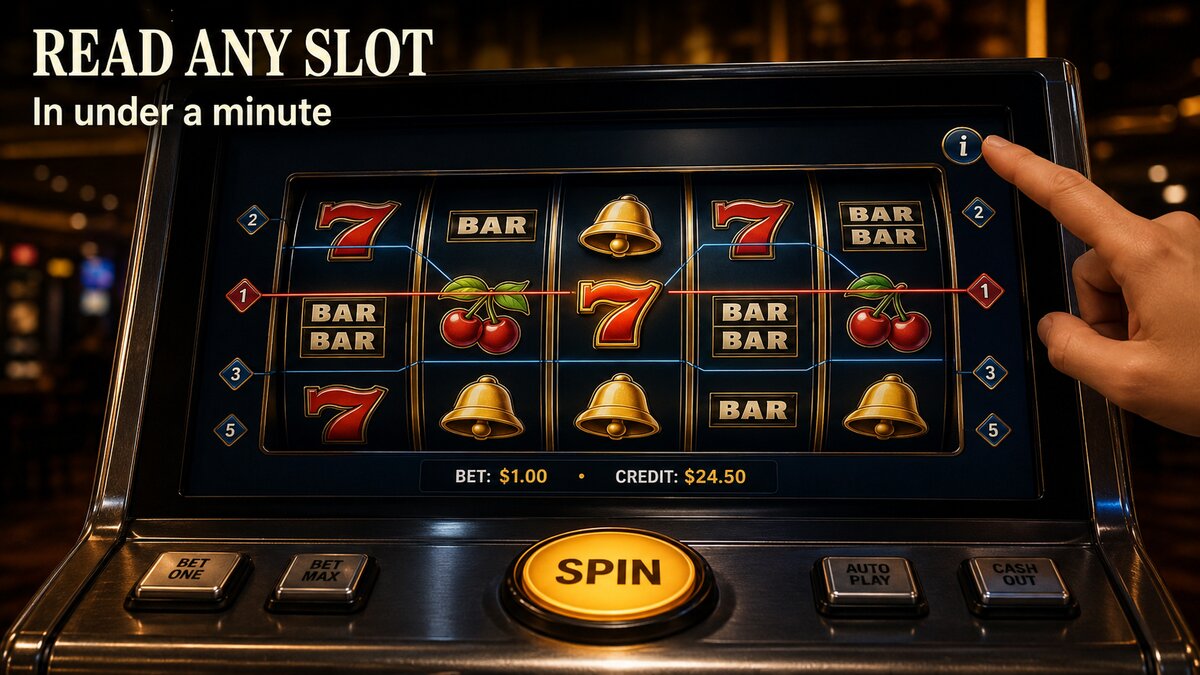
A slot machine will never tell you when it will pay, but it will tell you a surprising amount about whether it is worth playing at all. Almost everything below lives in the help or info screen, the button players press least. If you are brand new to paytables and reels, the basics of how to play slots take about five minutes to learn; the checklist below assumes nothing.
- RTP (return to player). This is the long-run payback percentage. The difference sounds small but is not: a 92 percent game costs you about $8 for every $100 cycled through it, while a 96 percent game costs about $4. Same money, half the loss rate. RTP is printed in the help menu of most video and online games, and comparing the best RTP slot machines before you sit down is the single highest-value habit a slot player can build.
- Volatility (variance). High volatility means rare but big wins; low volatility means frequent small ones. Even when it is not labeled, the paytable shape gives it away: a huge top prize sitting above weak mid-tier payouts is a high-volatility game. A flatter paytable with solid medium wins is a low-volatility game.
- Hit frequency. This is the percentage of spins that return any win at all, typically somewhere between 20 and 35 percent. It is not the same thing as RTP. A game can pay something on a third of spins and still hold more of your money than one that hits half as often.
- Paylines, ways, and qualifying bets. Some progressives and bonus features require a maximum bet or a side bet to be eligible. Check this before you spin. Few feelings on a casino floor are worse than lining up the jackpot combination at a bet level that did not qualify for it.
- Denomination. Higher-denomination machines return more on average, and this is published data, not theory. Nevada Gaming Control Board figures for 2024 show penny slots statewide holding about 9.4 cents of every dollar wagered (roughly a 90.6 percent return), while $5 machines held about 4.4 cents (roughly 95.6 percent). Playing a denomination above your comfort level is a mistake, but if your bet size is the same either way, fewer lines on a higher denomination usually beats more lines on a penny game.
How to Pick a Winning Slot Machine (What Actually Improves Your Odds)
No machine can be a guaranteed winner, so “picking a winning slot machine” really means stacking every available percentage in your favor before the first spin. Here is the full list, in order of impact.
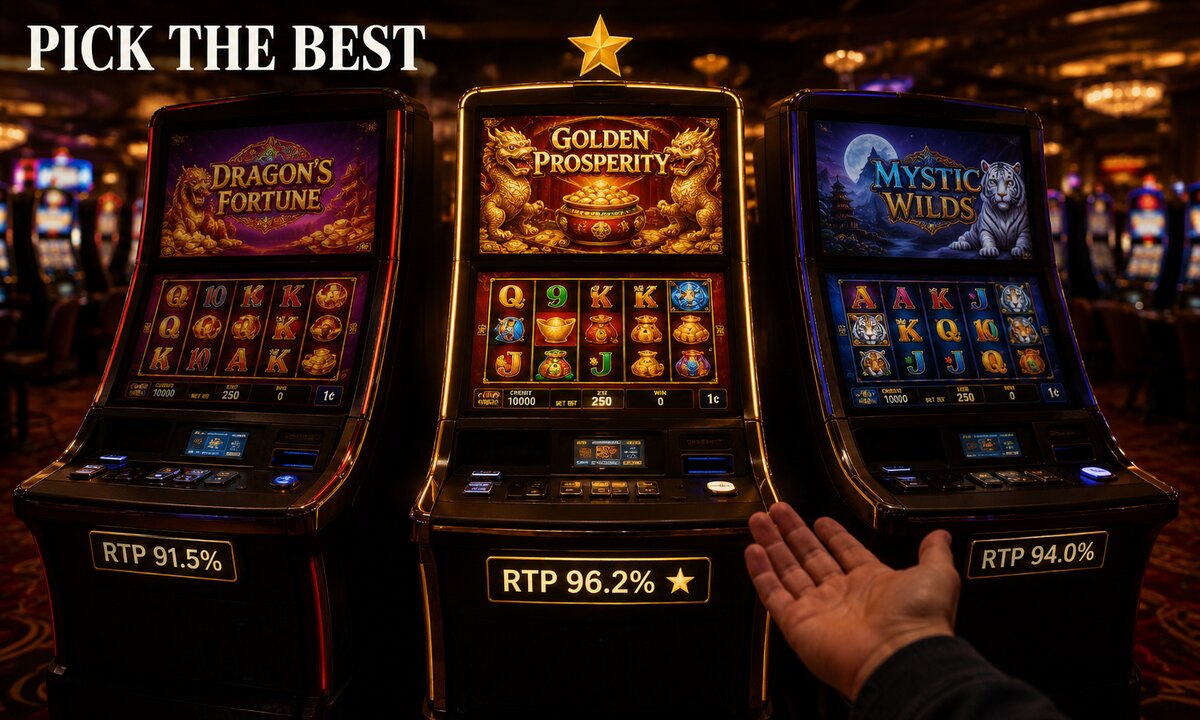
Three factors actually shift slot odds.
- Choose the highest RTP you can find. On the floor, that often means older classics, video poker bars, and locals casinos rather than flashy new cabinets on the main drag. The Nevada numbers make the geography plain: Strip penny slots held about 11 percent of wagers in 2024, while locals casinos in North Las Vegas and the Boulder area held under 9 percent on the same denomination. Two cents per dollar compounds fast over a long session.
- Match volatility to your bankroll and your goal. Small budget and you want playtime? Pick low volatility and accept smaller wins. Chasing a hand pay and willing to bust trying? High volatility is the honest choice. Most frustration at slots comes from playing a volatility level that does not match the goal.
- Hunt must-hit-by progressives near their cap. As covered above, this is the one situation where a specific machine is measurably better right now than its neighbors. Scan the meters as you walk; it costs nothing.
- Prefer smaller fixed jackpots over giant wide-area progressives. Megabucks-style games pool a jackpot across many casinos, which is why the number is enormous and why your odds of hitting it are lottery-grade, with payback shaved to fund the prize. A standalone game with a 1,000x top prize pays its jackpot thousands of times more often. Decide whether you are buying a realistic shot or a daydream, and price it accordingly.
- Check your state’s published payout reports before you go. Most US gaming regulators publish payback or win-percentage data by market and denomination. Nevada’s monthly revenue reports from the Nevada Gaming Control Board are the best known, and New Jersey publishes per-casino machine returns. Ten minutes of reading tells you which casinos in your area run looser floors.
- Test games for free before you fund them. On the floor, players-club free play lets you trial candidate machines at zero cost. At home, most titles exist as free slots you can run on your phone to learn a game’s bonus behavior and volatility feel before a single real dollar is at risk.
- Set your exit rules before you spin. Decide a loss limit and a win target in advance, and bank half of any large bonus win immediately. Machine selection means nothing without an exit plan, because the math guarantees that every machine eventually takes back unlimited playtime.
Here is how the major machine types compare when you put all of that together:
| Machine type | RTP tendency | Volatility | Realistic hit odds | Best for |
|---|---|---|---|---|
| Penny video slots | Lower (high 80s to low 90s in Nevada data) | Medium to high | Frequent small wins, rare big ones | Long sessions on a small budget |
| Dollar classic reels | Higher (mid 90s) | Medium | Solid line hits, modest jackpots | Better payback without high-limit stakes |
| Video poker | Highest (96 to 99 percent with correct strategy) | Low to medium | Pays something often | Players willing to learn basic strategy |
| Must-hit-by progressives | Varies; value improves near the cap | High | Jackpot guaranteed by the cap, not guaranteed to you | Meter watchers with patience and bankroll |
| Wide-area progressives (Megabucks-style) | Lowest | Extreme | Lottery-grade | Chasing a life-changing number with eyes open |
Slot Machine Myths: Signs That Mean Absolutely Nothing
Every myth below survives because it sounds like insider knowledge and because wins occasionally follow it by pure chance. None of them survive contact with how regulated machines are actually built.

Prediction tools don’t work on slots.
| The myth | Why people believe it | The reality |
|---|---|---|
| A machine that has not paid in hours is due | We expect randomness to even out quickly, so a long dry spell feels like pressure building | The gambler’s fallacy. The RNG has no memory, so the odds on the next spin are identical whether the machine just paid a jackpot or has not paid all day |
| Hot machines keep paying; cold machines should be avoided | Streaks are real and easy to spot, so they feel meaningful | Streaks exist only in hindsight. Independent outcomes mean a hot machine is no likelier to stay hot than a cold one is to stay cold |
| Casinos flip a switch to pay out after promotions, holidays, or on weekend mornings | Crowded floors produce more visible jackpots, so wins cluster in memory around busy dates | Regulated casinos cannot legally change payback on a whim. Altering a machine’s return involves approved software and documented compliance procedures, not a dial in a back office |
| Machines near entrances and aisles are set loose | It was a genuinely discussed placement tactic decades ago, so it lingers in every tip list | At best a historical practice. Modern published payback data is reported by denomination and market, not floor position, and there is no verifiable evidence today’s casinos seed walkway machines |
| Time of day or day of week changes the odds | More players at night and on weekends means more witnessed wins | The RNG does not know what time it is. Payback settings do not run on a schedule |
| Playing with a players card tightens the machine | The card feels like surveillance, and losses while carded sting more | The card reader and the game logic are separate systems. Payback is identical carded or not, so skipping the card only costs you comps and free play |
| Reel teases and near misses mean it is about to hit | Two jackpot symbols with a third stopping just off the line feels agonizingly close | Near misses are designed presentation, a well-documented piece of slot psychology. The outcome was decided before the reels moved, so “almost” does not exist |
| A casino tech or attendant can point you to a machine that is ready | Insider information is seductive, and staff really do see a lot of jackpots | Staff cannot see future RNG outputs, because nobody can. Anyone who genuinely could would not be sharing it on a casino floor |
What Is the $20 Method, and Does It Work?
The $20 method is simple: insert $20 into a machine, play a fixed number of spins or until you are up or down by a set amount, then cash out and move to the next machine. The idea is that you sample many machines and stay longer on the ones that pay early.
Here is the honest verdict. As a way to find machines that are about to hit, it does not work and cannot work, because early results say nothing about future spins. As bankroll discipline, it is genuinely useful: it caps your loss on any single machine, forces regular cash-out decisions, and keeps a session from disappearing into one cabinet. In other words, it is a budgeting tool wearing a strategy costume. The related 5-spin method, where you abandon any machine that gives nothing back in five spins (no small payout, or “taste”), earns the same verdict for the same reason.
A Realistic 5-Step Routine for Your Next Casino Visit
Pull all of the above together and this is what a sharp slot session actually looks like, start to finish:
- Pick the right casino before you pick a machine. Check your state regulator’s payout report and favor the market tier that returns more. In Las Vegas, that means locals casinos over the Strip if payback is your priority.
- Walk the floor before you sit. Scan for must-hit-by meters above 90 percent of cap and for persistent-state games abandoned with visible banked progress. This five-minute lap is the only legitimate “machine reading” that exists.
- Read the help screen before inserting money. Confirm the RTP if listed, judge volatility from the paytable shape, and check whether the jackpot or feature you actually want requires a qualifying bet.
- Set a loss limit and a win exit rule, out loud if you have to. Solid bankroll management beats every machine-picking trick on this page combined, because it is the only one that works on every spin.
- Use free play for testing, bank half of big wins, never chase. Trial machines with players-club credit, pocket half of any bonus windfall immediately, and when the loss limit hits, it hits.
One last honest line before the FAQ: the only guaranteed winner on any casino floor is the casino. Played with the selection habits above, slots can be reasonably priced entertainment. Played as an income plan, they are a tax on hope. Budget accordingly.
It’s important to play responsibly. If gambling has stopped feeling like entertainment for you or someone close to you, free and confidential help is available 24/7. In the US, call or text 1-800-GAMBLER, the National Council on Problem Gambling helpline.