Roulette Table Layout Explained, Bets, Odds & Payouts

Key Takeaways
- The roulette table layout is a numbered betting grid (1–36 plus 0 or 0/00) that mirrors the pockets on the wheel and dictates every betting option available.
- European roulette features a single zero layout with a 2.70% house edge, while American roulette includes both 0 and 00, raising the house edge to 5.26%.
- Inside bets sit within the grid for higher payouts; outside bets run around the edges and cover larger number sets with smaller payouts but better hit frequency.
- French roulette uses the same single-zero layout as European but adds rules like la partage or en prison that improve odds on even money outside bets.
- Reading the table—columns, dozens, and special sections—matters more for smart play than memorising wheel number sequences.
Introduction to the Roulette Table Layout
Whether stepping into a Las Vegas casino or preparing to play roulette online for the first time, the roulette table layout is our primary interface for placing every wager. Understanding this betting surface is the first step toward confident play.
A standard roulette layout consists of a rectangular betting cloth—typically green felt in most casinos—with numbers 1 through 36 arranged in a 3×12 grid. At the top of the grid sit one or two green zero boxes depending on whether the table is European or American.
Every pocket on the roulette wheel has a corresponding betting space on the table. A European wheel with 37 numbered pockets (0–36) matches a layout with 37 betting positions. An American roulette wheel adds the 00 pocket, bringing the total to 38.
While the wheel’s number sequence appears almost random—designed to alternate red and black colours and balance high-low distribution—the table grid is deliberately organised into three columns, twelve horizontal rows, and clearly labelled outside betting areas. This organisation makes it easy to place bets and verify chips are positioned correctly.
European vs American Roulette Table Layouts
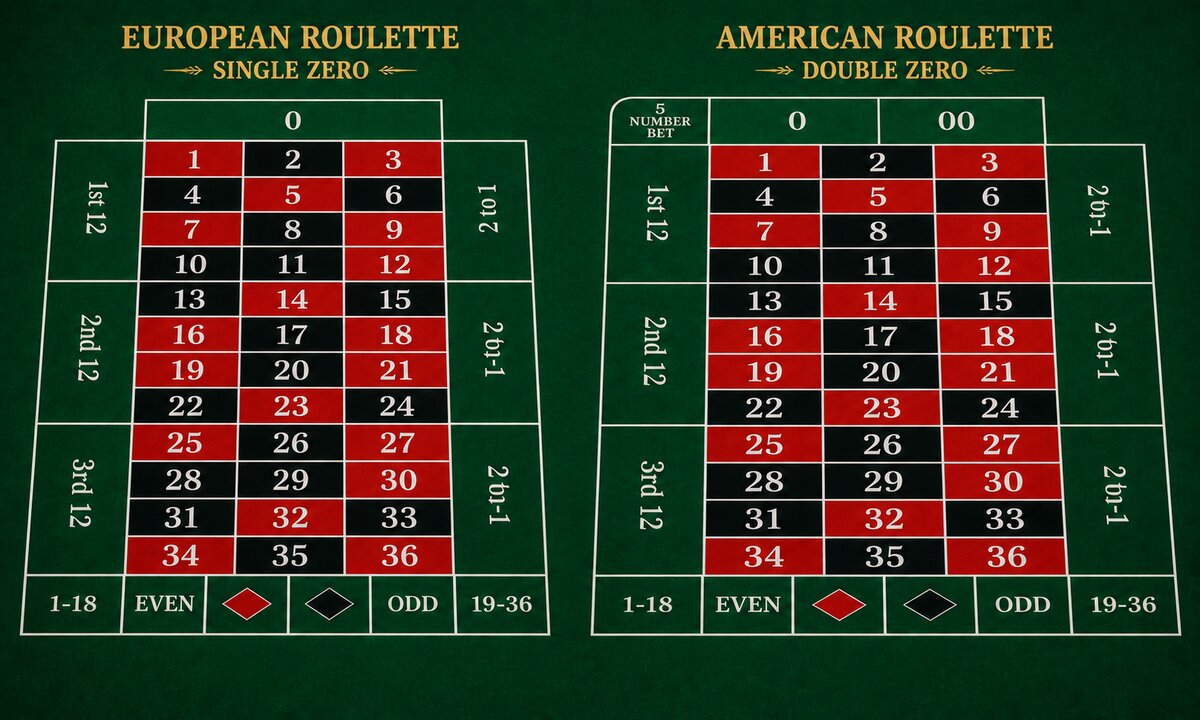
EU keeps one zero; US adds 00 plus a 5-number bet.
The key visual difference between roulette layouts comes down to the number of green zero boxes positioned at the top of the grid. This single distinction affects everything from betting options to long-term expected return.
European Single Zero Layout
European roulette uses a single zero roulette wheel with exactly 37 numbers represented on the betting layout. The table shows a single green box labelled “0” positioned above the 1–36 grid. This configuration is standard in London casinos, throughout Europe, and across most online casino platforms that default to European rules.
The house edge on a European table runs approximately 2.70% across all standard bets. That figure comes from the mismatch between 37 actual pockets and payouts calculated as if there were only 36 numbers.
American Double Zero Layout
American roulette expands to 38 numbers by adding a separate 00 pocket. On the betting layout we see two green boxes—typically labelled 0 and 00—positioned above or beside the main grid.
This double zero configuration dominates US land-based casinos in Las Vegas, Atlantic City, Nevada, and regional venues like those in Oklahoma. The additional zero pocket raises the house edge to approximately 5.26% under standard rules.
| Layout Type | Zero Boxes | Total Numbers | House Edge |
|---|---|---|---|
| European | Single 0 | 37 | 2.70% |
| American | 0 and 00 | 38 | 5.26% |
| Triple Zero | 0, 00, 000 | 39 | 7.69%+ |
A player walking into a London casino in 2026 will almost certainly encounter single-zero tables, while someone visiting a Nevada or Oklahoma venue will likely face the double zero American version. Knowing this distinction before sitting down helps clarify the actual odds in play.
Reading the Number Grid on a Roulette Table
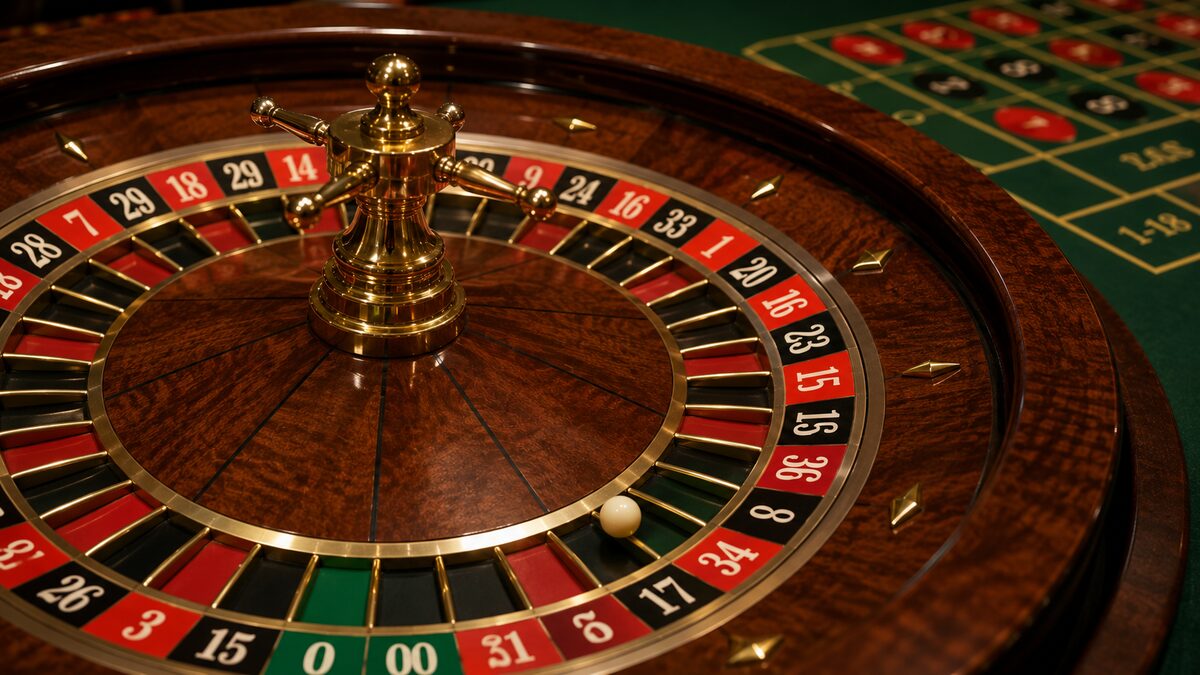
European wheels have 37 pockets; American wheels add 00.
The number grid—known as the “inside” area—is where all 36 numbered positions are displayed in three vertical columns and twelve horizontal rows. This is the core of every roulette layout and where higher-risk wagers are placed.
Column Structure
The grid follows a specific ascending pattern:
- First column: 1, 4, 7, 10, 13, 16, 19, 22, 25, 28, 31, 34
- Second column: 2, 5, 8, 11, 14, 17, 20, 23, 26, 29, 32, 35
- Third column: 3, 6, 9, 12, 15, 18, 21, 24, 27, 30, 33, 36
Each number occupies its own rectangular box within this organised system. The zeros (0 in European, 0 and 00 in American) sit in separate rectangles at the top end of the grid, coloured green to distinguish them from the red and black numbers.
Color and Parity
On the actual felt, most casinos do not colour each individual box red or black. Instead, the colour designation comes from the roulette wheel pockets themselves. However, the number’s parity (odd or even) and range (1–18 vs 19–36) are essential for understanding the outside bets that surround the grid.
Chip Placement Basics
Players physically interact with the grid through precise chip placement:
- Straight up bet: Place chips directly in the centre of a single number square.
- Split bet: Position chips on the line between two adjacent numbers.
- Corner bet: Set chips at the intersection where four numbers meet.
This deliberate design with clear borders and intersection points lets us signal an intended bet type without ambiguity—a system that works identically whether at a physical table or playing roulette games online.
Inside Bets on the Roulette Table Layout
Inside bets are placed within the 1–36 grid plus the zero positions, covering individual numbers or tightly defined combinations. These wagers offer higher payouts to compensate for their lower probability of success.
Inside Bet Types and Payouts
| Bet Type | Coverage | Payout Odds | Example |
|---|---|---|---|
| Straight Up | Single number | 35 to 1 | Chip on 17 |
| Split | Two adjacent numbers | 17:1 | Chip on line between 17–18 |
| Street | Three numbers in a row | 11:1 | Chip on edge of 1-2-3 row |
| Corner / Square | Four numbers at intersection | 8:1 | Chip where 17-18-20-21 meet |
| Double Street / Line | Six numbers (two rows) | 5:1 | Chip covering 1-2-3-4-5-6 |
The roulette layout is specifically designed with clear borders and intersections so a single bet consists of one chip placed on the right position. For example, placing a chip on the corner where 17, 18, 20, and 21 meet signals a corner bet covering all four numbers without any verbal announcement required.
Why Inside Bets Appeal to Certain Players
These payout odds remain identical on European and American tables—a straight up bet always pays 35 to 1 regardless of which layout we’re using. What changes is the actual probability of winning due to the different pocket counts, which affects the underlying house edge.
Inside bets occupy less physical space on the cloth and tend to attract players who:
- Have specific “lucky numbers” they want to back
- Prefer higher volatility and the chance for dramatic winnings
- Want to place more bets across multiple individual numbers
- Enjoy the tactical element of covering adjacent numbers through splits and corners
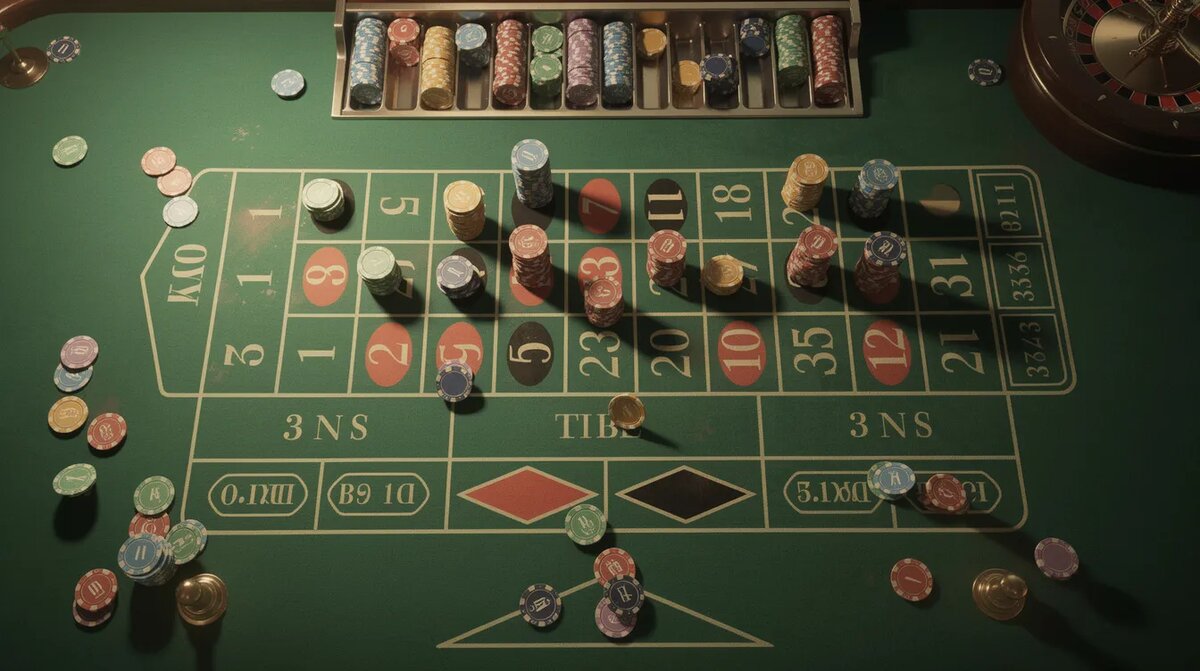
Inside bets sit on numbers, splits, corners, and streets.
Outside Bets and the Edge of the Layout
Outside bets are placed on areas surrounding the number grid and cover larger groups of numbers. They offer lower payouts but significantly better hit frequency, making them popular with players who prefer steadier, less volatile play.
Even Money Bets
Six main even money outside bets appear in large, clearly labelled boxes along the outer edge of the layout:
- 1–18 (Low / Manque): Covers all numbers from 1 through 18
- 19–36 (High / Passe): Covers all numbers from 19 through 36
- Red: All red numbered pockets
- Black: All black numbered pockets
- Even: All even numbers (2, 4, 6…36)
- Odd: All odd numbers (1, 3, 5…35)
Each pays 1:1, meaning a profit equal to the original bet on a win.
2:1 Outside Bets
The layout also features 2:1 betting options that cover twelve numbers each:
- Column bets: Located at the bottom of each of the three columns, covering twelve numbers in that vertical line.
- Dozen bets: Three boxes marked “1st 12” (numbers 1–12), “2nd 12” (numbers 13–24), and “3rd 12” (numbers 25–36).
The Zero Problem
When the roulette ball lands on 0 or 00, all outside bets lose under standard American and European roulette rules. This is precisely how the house edge is created. French roulette applies special rules that partially protect even money bets when zero hits—a significant advantage covered in the next section.
Beginners commonly start with outside bets because the layout labels are large, easy to read, and offer simpler odds understanding. Seeing “RED” or “EVEN” on the cloth makes the betting options immediately clear.
Special Layout Features in French and European Roulette
Some European and French roulette tables display extra markings or track-style diagrams for announced bets, though these are often separate from the main betting cloth. Understanding these features can unlock additional betting strategies.
French Language Labelling
French roulette uses the same single-zero 0–36 grid as European roulette, but the table wording appears in French:
- Pair: Even numbers
- Impair: Odd numbers
- Manque: Numbers 1–18 (Low)
- Passe: Numbers 19–36 (High)
This linguistic difference doesn’t change the fundamental roulette rules or payouts—it’s purely a labelling convention traditional to French tables.
Racetrack Diagrams
High-end tables, especially in Monte Carlo or premium European casinos, often include visual references or side panels showing wheel segments. These oval “racetrack” diagrams map to sections like:
- Voisins du Zéro: 17 numbers surrounding zero on the wheel
- Tiers du Cylindre: 12 numbers on the opposite side of the wheel from zero
- Orphelins: The 8 remaining numbers not covered by the other sections
These special section bets are declared verbally (announced) and placed by the croupier on the player’s behalf, covering specific number clusters on the main grid.
La Partage and En Prison Rules
The real advantage of French roulette comes from rules that apply to even money outside bets when zero hits:
- La Partage: Half the wager is returned immediately when zero wins.
- En Prison: The bet is held “in prison” for the next spin; if the even money bet wins, the original bet comes back.
These rules reduce the effective house edge on even money bets to approximately 1.35%—significantly better odds than standard European or American roulette. Not all tables offer them, so check before sitting down if betting strategies will focus on even money positions.
How the Layout Shapes Roulette Odds and House Edge
Although multiple bet spaces exist across the roulette layout, the house edge remains effectively the same on all standard bets within a given wheel type. This is because payouts are calibrated to a 36-number ideal, regardless of actual pocket count.
The Zero Effect
Zeros are what create the house edge in roulette:
- A single zero on a 37-pocket wheel produces approximately 2.70% edge.
- Adding 00 on a 38-pocket wheel raises this to approximately 5.26%.
- Some casinos experiment with triple-zero layouts (0, 00, 000) that push the house edge above 7%.
The Venetian in Las Vegas has introduced such triple-zero games, adding a third green space that further dilutes winning probabilities without adjusting payouts proportionally.
Uniform Negative Expectation
A straight up bet and a column bet share the same underlying negative expectation within their respective table types. The difference lies in risk profile:
- Inside bets offer dramatic swings with lower hit frequency.
- Outside bets provide steadier results with higher probability but smaller payouts.
- Long-term expected loss remains proportional to total wagered, regardless of bet type.
Quick Visual Assessment
Before sitting down at any roulette table, glance at the top of the betting layout:
| What You See | What It Means |
|---|---|
| Single green 0 box | European / French table, 2.70% edge |
| Two green boxes (0, 00) | American table, 5.26% edge |
| Three green boxes | Triple-zero table, 7%+ edge |
This simple visual check takes seconds and immediately tells us whether the table offers better odds or a more aggressive house advantage.

Live roulette tables typically seat up to 7 players.
Practical Tips for Using the Roulette Table Layout
Understanding the layout conceptually is one thing—using it smoothly in actual play requires practical awareness. These tips help avoid common mistakes and play more confidently.
Start with Outside Bets
Newcomers should locate and use the large outside bet areas first. Red or black, even or odd, and the 1-18 / 19-36 positions are clearly labelled and offer the simplest entry point. Get comfortable with chip placement and game rhythm before mixing in inside bets.
Check Table Limits
Many casinos in 2026 post separate minimums for inside versus outside sections on the same layout. A table limit sign might show “$5 inside, $10 outside” meaning total inside bets must meet the $5 minimum, while each outside bet must be at least $10. Misunderstanding these limits causes frustration—confirm before placing chips.
Chip Placement Etiquette
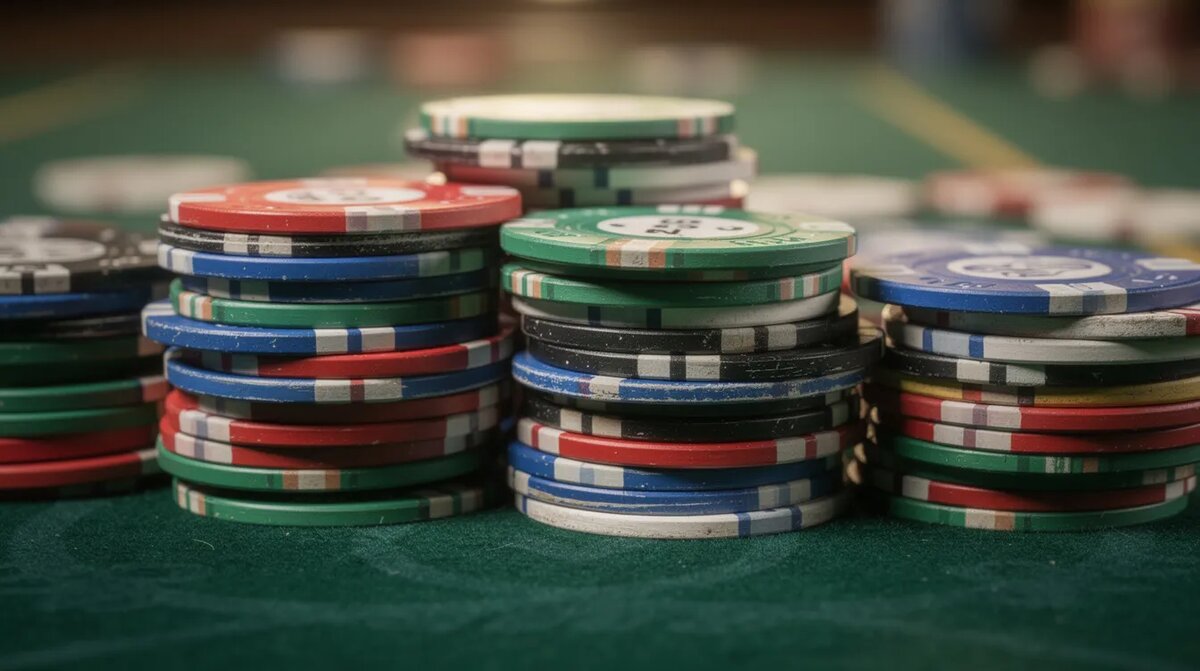
Stack chips cleanly — color signals ownership to the dealer.
- Keep chips neatly within the intended rectangle or precisely on intersection lines.
- Avoid overlapping other players’ bets (colour-coded chips distinguish ownership).
- Let the dealer announce adjustments and reposition chips if needed.
- Stack chips cleanly rather than scattering them.
Online Roulette Considerations
When playing roulette online, digital layouts replicate these sections with clear labelling. Most online casino interfaces let players hover or tap a betting area to see exactly which numbers it covers before committing chips.
Use this preview feature to verify the intended bet—especially useful when learning split, corner, or double street positions. Browse the full table games library to see how each variant translates the physical layout into a digital interface.
Avoid Losing Streak Chases
No betting system—including the martingale system, fibonacci system, or d’alembert system—changes the fundamental math of the layout. These betting strategies may structure wagers, but they don’t overcome the house edge built into every roulette table. Chasing previous losses with larger bets after a losing streak doesn’t improve odds; it increases the risk of hitting the table limit before recovering.