Blackjack Card Values: Complete Guide to Card Worth and Hand Calculations

Introduction
Blackjack card values determine each card’s point worth and form the foundation of every decision you make at the blackjack table. Understanding these values is essential before you play blackjack, as they dictate whether you hit, stand, double, or split in any given situation.
This guide covers basic card values, hand calculations, soft and hard hand distinctions, and how these concepts connect to strategic play. We’ll focus on the fundamentals that beginner to intermediate players need to master, while advanced topics like card counting systems and shuffle tracking fall outside this article’s scope.
The direct answer: Number cards (2-10) are worth their face value, face cards (Jack, Queen, King) are worth 10 points each, and aces are worth either 1 or 11—whichever benefits your hand without causing a bust.
By the end of this guide, you’ll be able to:
- Identify the exact point value of every card in the deck
- Calculate hand totals quickly and accurately, including complex ace scenarios
- Distinguish between soft hands and hard hands
- Recognize a natural blackjack and understand its significance
- Apply card value knowledge to make better playing decisions
Understanding Basic Blackjack Card Values
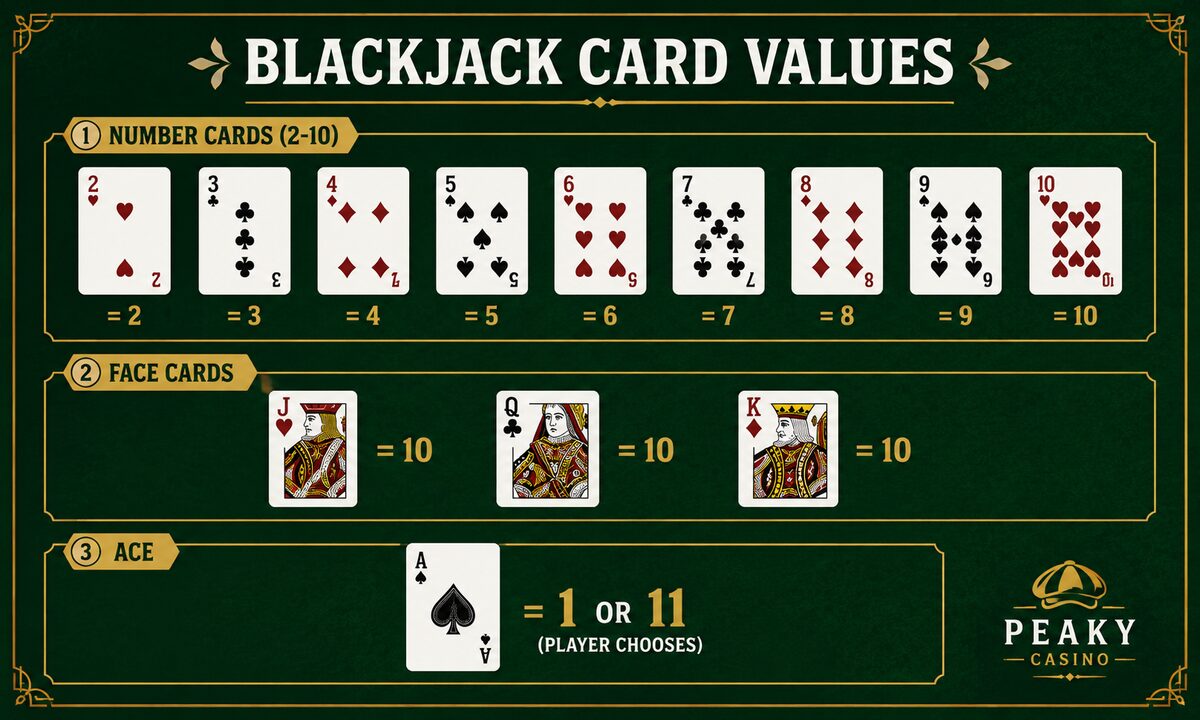
Aces can be 1 or 11 — player picks each turn.
Card values represent the point system used to determine your hand value in any blackjack game. The goal is straightforward: reach a total of twenty one or get closer to 21 than the dealer’s hand without exceeding it. Every strategic decision flows from accurately assessing these totals.
Number Cards (2-10)
Number cards hold their printed face value with no exceptions. A 2 of hearts equals 2 points, a 7 of spades equals 7 points, and a 10 of clubs equals 10 points. This applies regardless of suit—hearts, diamonds, clubs, and spades carry identical point values for the same rank.
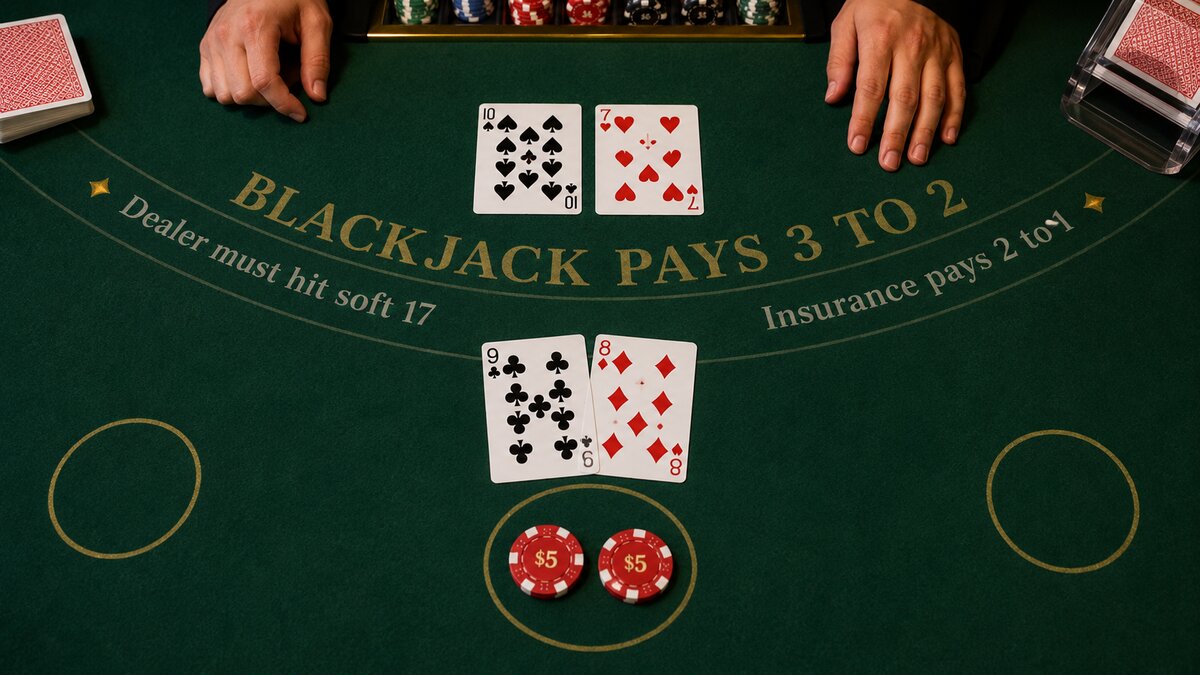
The simplicity of number cards makes them the easiest to calculate in any blackjack hand. When you see a 5 and an 8 dealt face up in front of you, you instantly know your total is 13.
Face Cards (Jack, Queen, King)
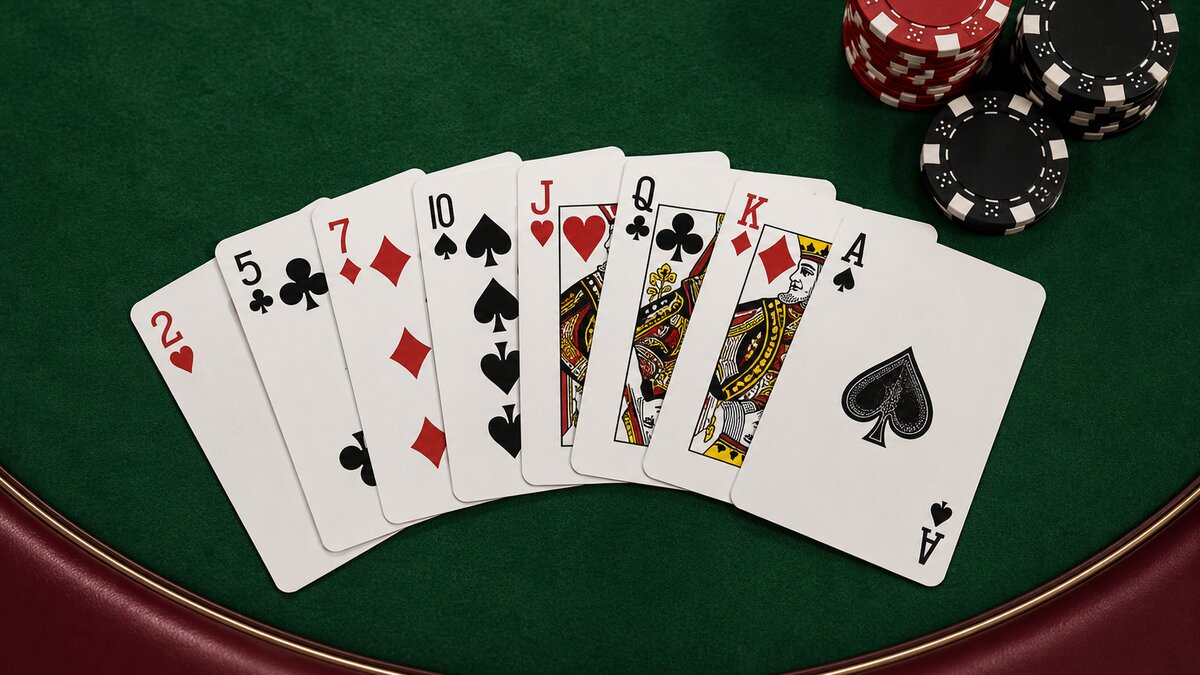
Face cards—sometimes called picture cards—are all worth 10 points each. The jack queen and king hold the same value as a printed 10, making them equivalent for hand calculation purposes.
This uniformity creates significant strategic implications. In a standard 52-card deck, 16 cards carry a 10-point value (four 10s plus four Jacks, four Queens, and four Kings). This high concentration of 10-value cards influences hitting decisions, doubling strategies, and the frequency at which blackjack occurs.
Aces (Flexible Value)
The ace card is unique because it can count as either 1 or 11 points based on what benefits your hand. This flexibility makes aces the most valuable cards in blackjack.
When you receive an ace, it automatically starts as 11. If subsequent cards push your total over 21, the ace converts to 1 to prevent busting. This automatic adjustment happens without any action required from you—the best value applies by default.
This dual nature creates what players call “soft” hands, which we’ll explore in detail after covering hand calculation methods.
Calculating Your Hand Total
Now that you understand individual blackjack card values, let’s apply this knowledge to calculating complete hands. Accurate calculation is essential before deciding whether to take another card or stand on your current total.
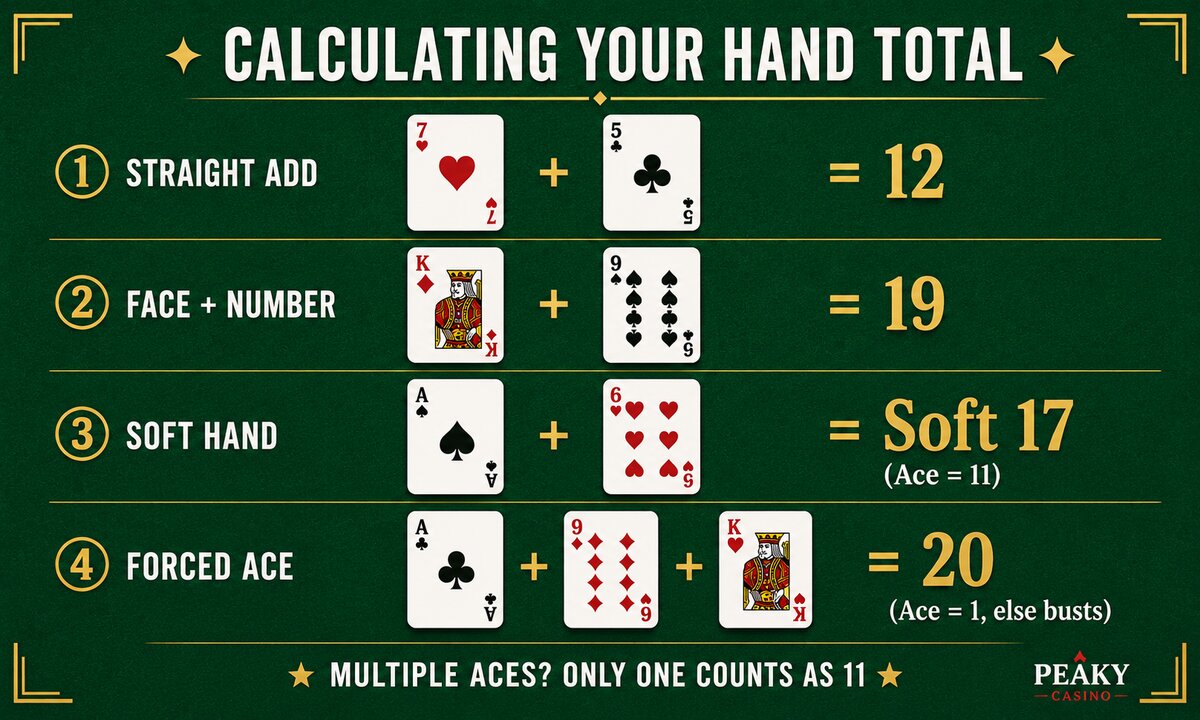
Multiple aces? Only one counts as 11.
Basic Addition Method
Follow this process to calculate any hand:
- Add the face values of all number cards (2-10)
- Count each face card (J, Q, K) as 10 points
- For aces, use 11 if the total stays at or below 21; otherwise use 1
Example calculations:
- 7 + 5 = 12 (straightforward number cards)
- King + 9 = 19 (face card as 10 plus number card)
- Ace + 6 = 17 (ace counted as 11 for a soft hand)
- Ace + 9 + King = 20 (ace must be 1 since 11 + 9 + 10 = 30 would bust)
These calculations happen quickly once you’ve memorized the basic card values—a skill that becomes automatic with practice.
Handling Multiple Aces
When your hand contains multiple aces, only one can count as 11. Additional aces must be valued at 1 to prevent busting. This rule applies regardless of how many aces you hold.
Examples with multiple aces:
- A + A = 12 (one ace as 11, one as 1, creating a soft 12)
- A + A + 8 = 20 (11 + 1 + 8, still a soft 20)
- A + A + 9 + 3 = 14 (both aces must be 1 since 11 + 1 + 9 + 3 = 24 would bust)
Understanding this rule prevents costly miscalculations, especially when you split aces and receive additional cards on each separate hand.
Common Hand Examples
Practice with these calculations that represent typical scenarios at the blackjack table:
| Cards | Calculation | Total | Hand Type |
|---|---|---|---|
| K + 7 | 10 + 7 | 17 | Hard |
| 5 + 3 + 2 | 5 + 3 + 2 | 10 | Hard |
| A + 7 | 11 + 7 | 18 | Soft |
| A + 6 + 10 | 1 + 6 + 10 | 17 | Hard |
| A + 2 + 4 | 11 + 2 + 4 | 17 | Soft |
| Q + J | 10 + 10 | 20 | Hard |
Notice how the same numerical total (17) can be either soft or hard depending on whether an ace can still flex to 11. This distinction fundamentally changes how you should play the hand.
Soft Hands vs Hard Hands
The difference between soft and hard hands affects every strategic decision in blackjack. Basic strategy charts separate recommendations based on this distinction because the correct play often differs dramatically.
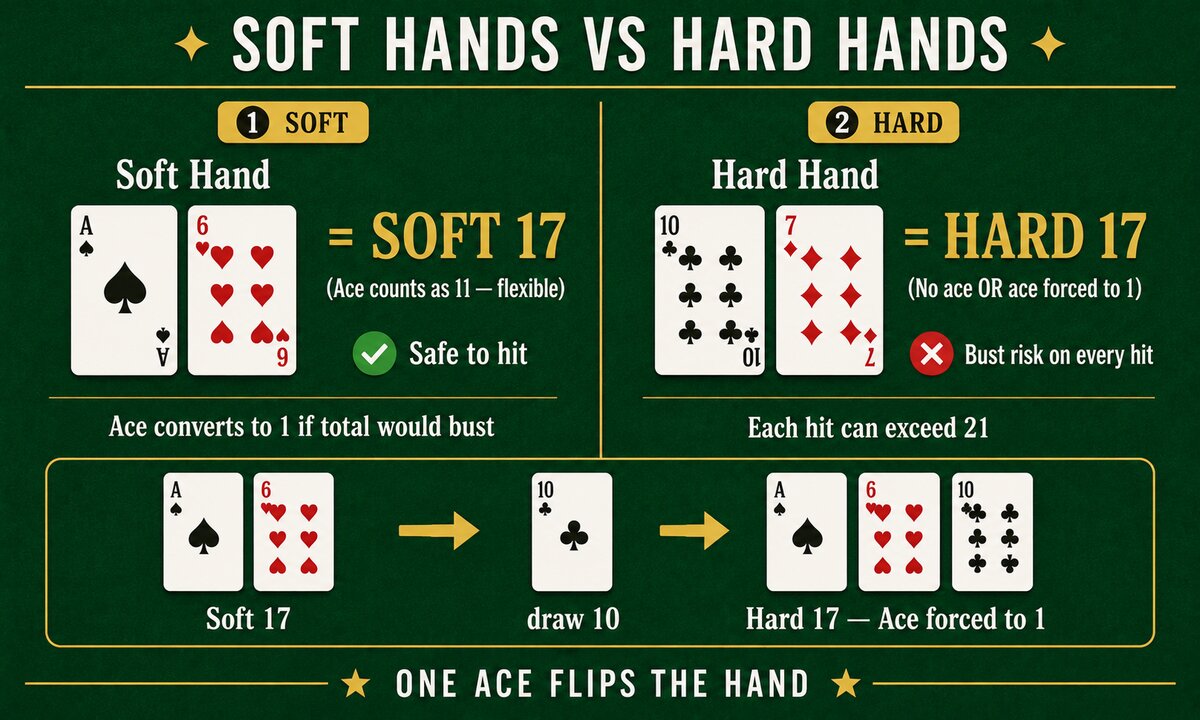
One ace flips the hand from soft to hard.
Soft Hand Definition and Examples
A soft hand contains at least one ace counted as 11 without causing a bust. The “soft” designation means you have flexibility—you can draw another card without risk of busting because the ace can convert to 1 if needed.
Soft hand examples:
- A-6 = Soft 17
- A-2-4 = Soft 17
- A-3-3 = Soft 17
- A-7 = Soft 18
- A-5-2 = Soft 18
With a soft 17, you can safely hit knowing that even a 10-value card only brings you to hard 17—not a bust. This safety net allows more aggressive play when the dealer shows weak upcards.
Hard Hand Definition and Examples
A hard hand either contains no aces or has aces that must count as 1 to avoid busting. These hands lack flexibility, making each additional card potentially dangerous.
Hard hand examples:
- 10-7 = Hard 17 (no ace present)
- A-6-10 = Hard 17 (ace forced to 1 since 11 + 6 + 10 = 27)
- 8-8-3 = Hard 19
- A-A-9-3 = Hard 14 (both aces forced to 1)
With hard hands, the risk of busting increases with every hit. A hard 17 has no safe cards to draw—any card 5 or higher causes you to automatically lose.
Strategic Implications Comparison
| Factor | Soft Hand | Hard Hand |
|---|---|---|
| Ace Flexibility | Yes—ace can convert to 1 | No—ace already counts as 1 (or no ace) |
| Busting Risk on Hit | Low | High |
| Double Down Opportunity | Often favorable | More restrictive |
| Basic Strategy Approach | More aggressive | More conservative |
| Example (17) | Hit or double vs. many dealer upcards | Stand vs. almost all dealer cards |
Most casinos require the dealer stands on hard 17 but may hit on soft 17. Understanding this distinction in house rules affects your expected outcomes and optimal strategy.
Special Card Value Scenarios
Certain combinations of card values create unique situations that carry specific rules and outcomes. Recognizing these scenarios immediately improves your gameplay efficiency.
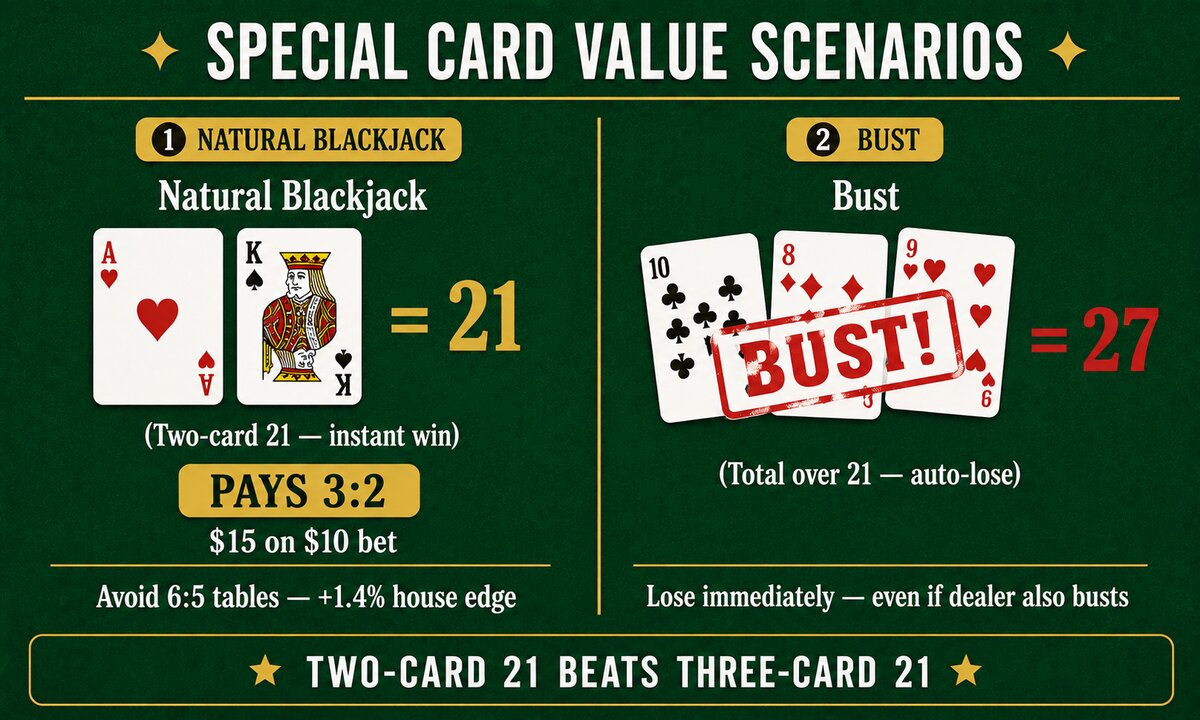
Two-card 21 beats three-card 21 at 3:2.
Natural Blackjack (21 with Two Cards)
A natural blackjack consists of an ace and a 10-value card dealt as your first two cards, totaling exactly 21. This combination represents the best possible outcome from your initial two cards.
All blackjack combinations:
- Ace + 10
- Ace + Jack
- Ace + Queen
- Ace + King
When blackjack occurs, you receive an automatic win and a premium payout—traditionally 3:2 at most casinos (winning $15 on a $10 bet). Some tables now offer 6:5 payouts, which increases the house edge by approximately 1.4%. Always check the posted blackjack rules before sitting down.
A natural blackjack beats any dealer hand totaling 21 with three or more cards. Unless the dealer has an ace showing (prompting insurance offers) or also reveals a natural blackjack, your hand wins immediately without further play.
Busting Scenarios
A bust occurs when your hand value exceeds 21 points. Once you bust, you automatically lose regardless of what happens with the dealer’s hand—even if a dealer bust occurs afterward.
Bust examples:
- 10-7-8 = 25 (bust)
- K-Q-5 = 25 (bust)
- 5-9-4-6 = 24 (bust)
- A-6-6-9 = 22 (ace converts to 1, but 1 + 6 + 6 + 9 still exceeds 21)
Understanding when the ace converts from 11 to 1 helps prevent miscalculation errors. In the last example, the player might initially calculate A-6-6 as soft 23, forgetting the ace automatically adjusts to create hard 13 before the final 9 is drawn.
Common Card Value Mistakes and Solutions
Even experienced players occasionally miscalculate hand totals. Recognizing these common errors helps you avoid them during casino play.
Miscounting Ace Values
The mistake: Using 11 for aces even when it causes a bust, or forgetting to convert aces when drawing additional cards.
The solution: Always start by counting an ace as 11. If your total exceeds 21, recount with the ace as 1. For multiple aces, remember only one can ever be 11—additional aces must be 1.
Practice examples:
- A + 9 + K: Start with 11 + 9 + 10 = 30 (bust), recount as 1 + 9 + 10 = 20 (hard 20)
- A + A + 8: Count as 11 + 1 + 8 = 20 (soft 20)
- A + 5 + 7: Start with 11 + 5 + 7 = 23 (bust), recount as 1 + 5 + 7 = 13 (hard 13)
Forgetting Face Card Values
The mistake: Thinking face cards have different values (like assigning 11 to a Jack or 12 to a Queen).
The solution: Memorize this simple rule: all picture cards equal 10. Jack, Queen, and King are identical in value to a printed 10. Whenever you see any face card, immediately think “10.”
For new players, practice by dealing random hands and quickly stating totals. Speed comes from automatic recognition rather than deliberate calculation.
Confusion Between Soft and Hard Hands
The mistake: Playing a hard hand as if it were soft (hitting aggressively) or playing a soft hand too conservatively.
The solution: Ask yourself: “Can I count an ace in this hand as 11 without going over 21?” If yes, you have a soft hand. If no (or there’s no ace), you have a hard hand.
Quick identification method: After calculating your total, check if subtracting 10 from an ace would keep you at or above 2 points. If you have A-7 (soft 18), converting the ace gives you 8—still playable. If you have A-6-10 and count the ace as 11 (27), you must use 1 (17), making it hard.
Conclusion and Next Steps
Mastering blackjack card values provides the foundation for every decision at the table. Number cards equal their printed value, face cards always equal 10, and aces flexibly count as 1 or 11. This knowledge enables accurate hand calculation, proper soft/hard hand identification, and recognition of natural blackjacks—all essential skills for strategic play.
Take these immediate actions:
- Memorize the three card value categories until recall is instant
- Practice calculating hand totals with a physical deck, dealing yourself two cards at a time
- Learn to distinguish soft hands from hard hands within seconds
- Study basic strategy charts that build on your card value knowledge
Related topics worth exploring include basic strategy optimization for different rule sets, understanding how dealer checks for blackjack, and learning how the dealer’s face down card (the hole card) affects optimal play in shoe games and double deck games.
Additional Resources
Quick Reference: Blackjack Card Value Chart
| Card | Point Value |
|---|---|
| 2-10 | Face value |
| Jack | 10 |
| Queen | 10 |
| King | 10 |
| Ace | 1 or 11 |
Practice Exercises
Calculate these hands and identify whether each is soft or hard:
- 9 + 4 + A = ?
- K + A = ?
- A + A + 6 = ?
- 7 + 8 + 3 = ?
- A + 5 + 10 = ?
Answers: 1) Hard 14; 2) Soft 21 (blackjack); 3) Soft 18; 4) Hard 18; 5) Hard 16
For continued learning, seek out basic strategy charts specific to common rule variations—whether the dealer stands or hits on soft 17, the number of decks in play, and surrender availability all affect optimal decisions. These charts transform your card value knowledge into a complete winning strategy framework.