Double Deck Blackjack Strategy: Master the Optimal Playing Approach

Introduction
Double deck blackjack strategy represents the mathematically optimized system of decisions for playing blackjack with exactly two standard 52-card decks. This approach maximizes player advantage by accounting for the unique probability shifts that occur when only two decks are in play, making it distinct from both single deck and multi deck games strategies.
This guide covers everything from basic strategy fundamentals through advanced card counting techniques, specifically tailored for double deck blackjack games. Whether you’re a recreational player looking to reduce losses or a serious player aiming to achieve advantage play, understanding these concepts transforms how you approach the blackjack table.
Direct answer: Using proper basic strategy in a double deck game reduces the house edge to approximately 0.35-0.40% under favorable rules, with skilled card counting potentially converting that into a small long-term player advantage.
By mastering double deck blackjack strategy, you will:
- Memorize the correct basic strategy charts for both S17 and H17 rule variations
- Understand how specific rules shift house edge and identify favorable table conditions
- Implement the Hi-Lo card counting system effectively in double deck games
- Recognize common strategic mistakes that cost measurable expected value
- Develop proper bankroll management for sustained play
Understanding Double Deck Blackjack Fundamentals
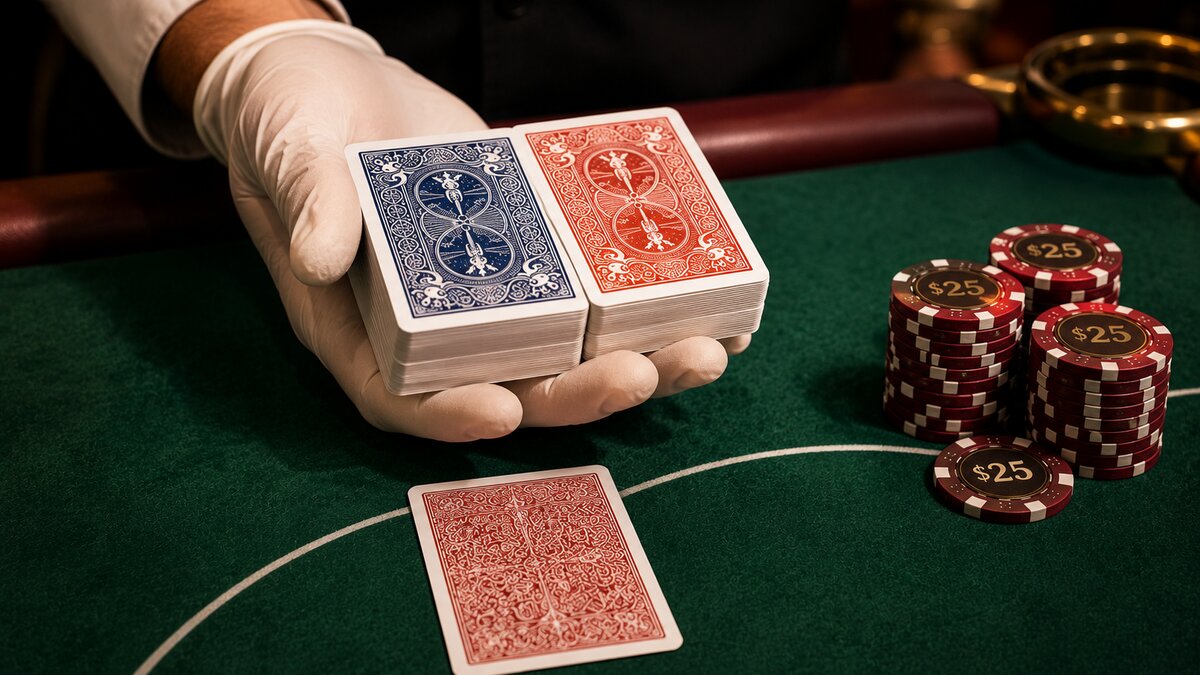
A double deck blackjack game uses exactly two standard 52-card decks shuffled together, totaling 104 cards in play. This deck count sits between single deck blackjack and six deck games, offering a strategic middle ground that combines favorable odds with reasonable game availability.
Understanding why deck count matters is essential for optimal play. Each card removed from a double deck game has greater relative impact on remaining probabilities than in eight deck games, but less impact than in a single deck game. This mathematical reality directly influences when to double, when to split aces, and how effective card counting becomes.
How Double Deck Differs from Other Formats
Compared to single deck blackjack, double deck games present a slightly higher house edge—typically 0.15-0.20% more. However, casinos often compensate for single deck’s player-favorable mathematics by restricting rules (disallowing double after split, implementing 6:5 payouts). Double deck games frequently offer more liberal basic strategy rules while retaining many probabilistic advantages.
Against six deck games and eight deck games, the double deck format provides clear benefits. Fewer decks mean better odds for the player: more frequent blackjacks, more powerful doubling opportunities, and dramatically more effective counting. In multi deck games, the dilution of favorable cards reduces strategic leverage significantly.
The explicit connection to strategy: because you’re working with only two decks, each ten-value card or ace counts more heavily toward remaining composition. This magnification effect makes precise strategy adherence and card tracking substantially more rewarding than in games with more decks.
Rule Variations and House Edge Impact
Rule variations can swing house edge dramatically in any double deck game. Understanding these shifts helps you identify tables worth playing:
| Rule Change | House Edge Impact |
|---|---|
| Dealer hits soft 17 (H17) vs stands (S17) | +0.20% to +0.25% |
| 6:5 blackjack payout vs 3:2 | +1.35% to +1.40% |
| No double after split allowed | +0.10% to +0.15% |
| No late surrender | +0.08% |
| No re splitting aces | +0.08% |
Under the best specific rules—dealer stands on soft 17, 3:2 payout, double after split allowed, late surrender available—basic strategy can push house edge down to approximately 0.20%. Under worse conditions (H17, 6:5, restricted doubling), that edge climbs to 0.60-0.70%, erasing much of the double deck advantage.
These fundamentals establish why basic strategy implementation isn’t optional—it’s the foundation for everything that follows in serious play.
Essential Double Deck Basic Strategy
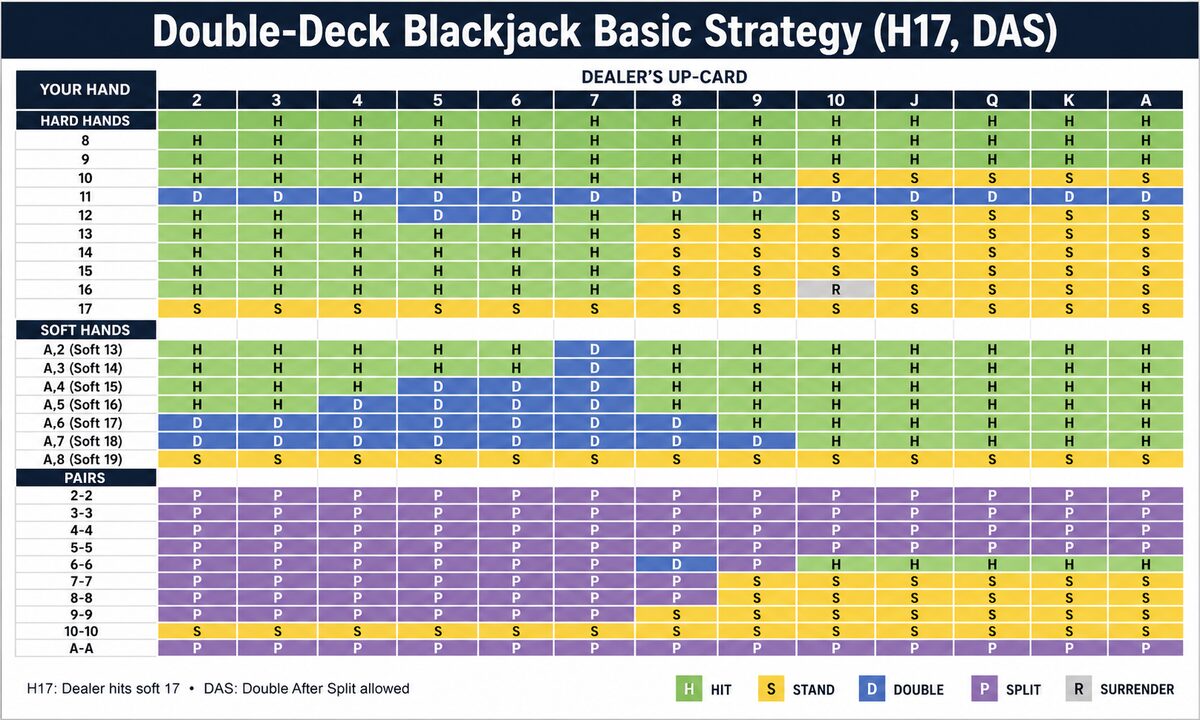
Double-deck H17 DAS edge sits near 0.30%.
Building on the rule variations discussed above, applying the correct basic strategy charts transforms theoretical knowledge into actual edge reduction at the blackjack table.
Double Deck Strategy Charts
Double deck blackjack strategy charts differ subtly but importantly from single deck and multi-deck versions. The primary distinction lies in how specific rules (particularly whether dealer hits or dealer stands on soft 17) alter borderline decisions.
Two separate charts exist: one for S17 games (dealer stands on soft 17) and one for H17 games (dealer hits soft 17). Key differences between these include:
- Soft 18 vs dealer ace: hitting becomes correct under certain H17 conditions
- Hard 11 vs ace: doubling may shift based on rule set
- Splitting 7s vs dealer 10: different optimal plays across rule variations
Memorizing both chart versions prevents costly errors. The Wizard of Odds maintains detailed double deck specific charts that account for these nuances.
Critical Playing Decisions
Hard totals between 8 and 11 represent your highest-leverage doubling opportunities in the double deck game:
- Hard 9: Double against dealer shows 3 through 6; otherwise hit
- Hard 10: Double against dealer’s upcard 2 through 9; hit against 10 or ace
- Hard 11: Double against most dealer upcards; H17 rules may modify the play against ace
Soft hands require careful attention because incorrect plays here compound quickly:
- Soft 17 (A,6): Always hit; never stand thinking 17 is “good enough”
- Soft 18 (A,7): Stand against dealer 2-8 in most conditions; hit or double against dealer 9 through ace depending on specific rules
- Soft 19-20: Stand—you’re already in strong position
Pair splitting guidelines follow predictable patterns:
- Always split aces: Two chances at 21 beats one soft 12
- Always split 8s: Two chances at 18 beats playing hard 16
- Never split 10s: 20 is too strong to break
- Never split 5s: Hard 10 doubling opportunity is superior
- Split 2s, 3s: Against dealer 2-7 when double after split allowed
- Split 9s: Against 2-6 and 8-9; stand against 7, 10, or ace
Insurance and Side Bet Avoidance
The insurance bet carries approximately 7.4% house edge in double deck—significantly worse than the main game. When the dealer shows an ace, declining insurance is mathematically correct for basic strategy players. Taking insurance represents one of the most expensive common mistakes.
Side bets like perfect pairs, lucky ladies, and other exotic wagers typically carry house edges between 3% and 20%. Compared to the sub-1% edge of the main game under optimal play, these represent extremely poor value. Unless you’re counting cards and specific conditions make a side bet advantageous (rare), avoid them entirely.
With basic strategy rules firmly understood, the path to advantage play becomes clear.
Advanced Double Deck Advantage Play Techniques
Once basic strategy becomes automatic, card counting transforms double deck blackjack from a negative-expectation game into potential profit. The dd game format particularly rewards counting because true count accuracy increases with fewer decks.
Hi-Lo Card Counting System Implementation
The Hi-Lo system remains the most widely used balanced counting method. Implementation in double deck games follows these steps:
- Assign point values: Cards 2-6 receive +1; cards 7-9 receive 0; cards 10-Ace receive -1
- Maintain running count: Track the cumulative total as cards are dealt throughout each hand
- Calculate true count: Divide running count by decks remaining (in double deck, this is 2, 1.5, 1, or 0.5 depending on penetration)
- Adjust bet sizing: Increase your initial bet when true count reaches +2 or higher; maintain minimum bets at neutral or negative counts
- Make strategy deviations: Alter basic strategy at specific true counts (standing on 16 vs 10 at high counts, taking insurance when true count exceeds +3)
Because you’re working with only two decks, running counts convert to larger true count swings more rapidly than in six deck games. A running count of +4 with one deck remaining produces true count +4, while the same running count in a six-deck shoe produces true count below +1.
Double Deck vs Multi-Deck Counting Comparison
| Criterion | Double Deck | Six Deck |
|---|---|---|
| Penetration | 60-75% typical | 70-85% typical |
| True count volatility | Higher (faster swings) | Lower (gradual changes) |
| Bet spread required | 1:4 to 1:8 often sufficient | 1:10 to 1:16 typically needed |
| Win rate per 100 hands | Higher per positive count | Lower per positive count |
| Detection risk | Moderate | Lower (larger crowds) |
For the card counter, double deck offers overall advantage through more frequent positive counts and greater mathematical edge when those counts occur. The tradeoff involves smaller bet spread requirements but potentially higher minimum bets and faster dealer awareness of betting patterns.
Professional blackjack players often prefer double deck when favorable conditions exist because the combination of better odds and effective counting produces superior win money rates compared to shoe games.
Common Double Deck Strategy Challenges and Solutions
Even experienced players encounter strategic pitfalls. Recognizing these common mistakes prevents costly errors.
Misapplying Single Deck Strategy
Problem: Using single deck blackjack charts or multi deck games charts for double deck play creates systematic errors. Decisions like soft 18 vs ace, hard 9 vs dealer 2, and splitting 7s vs dealer 8 differ across deck counts.
Solution: Memorize double deck specific charts. Practice identifying the deck count at any table before sitting down. When uncertain about a borderline decision, consult the correct chart rather than defaulting to another format’s strategy.
Poor Table Selection
Problem: Choosing games with unfavorable rule combinations—6:5 payouts, H17, no surrender, shallow penetration—eliminates any strategic advantage and makes even counting cards unprofitable.
Solution: Before placing your initial hand, verify: 3:2 blackjack payouts (critical), dealer stands on soft 17 (important), double after split allowed (valuable), late surrender available (helpful). Observe penetration before sitting—if the dealer shuffles with 40%+ of cards undealt, the game offers poor counting conditions.
Many casinos now post common rule variations on table felts. Read before you play.
Inadequate Bankroll Management
Problem: Insufficient funds force conservative average bet sizing during favorable counts or risk of ruin during normal variance. Both outcomes destroy expected value.
Solution: Maintain 40-50 times your maximum bet for basic strategy only play. For card counting with meaningful bet spread, build bankroll to 200+ times your maximum bet. This buffer accommodates the extremely unlikely event of extended losing streaks while enabling proper bet scaling during positive counts.
Your minimum bets during neutral counts and higher minimum bets during favorable conditions should both fall within comfortable bankroll percentages.
Conclusion and Next Steps
Double deck blackjack offers the optimal balance between favorable rules and strategic opportunity. With basic strategy reducing house edge to 0.35-0.40% and card counting potentially creating player advantage, this format rewards both casual and serious players who invest in learning proper technique.
Immediate next steps:
- Master the basic strategy chart for your preferred rule variation (S17 or H17)
- Practice with online simulators until decisions become automatic
- Learn the Hi-Lo counting system with emphasis on true count conversion for two decks
- Scout local casinos for favorable double deck games with 3:2 payouts and liberal rules
Related advanced topics worth exploring include shuffle tracking techniques for predicting favorable card clumps, team play concepts for larger bet spreads without detection, and progressive bankroll growth strategies for transitioning from recreational to professional blackjack play.
Additional Resources
Strategy Cards:
- Double deck basic strategy chart (S17 version) for when dealer stands on soft 17
- Double deck basic strategy chart (H17 version) for when dealer hits soft 17
Practice Tools:
- Online blackjack simulators with adjustable deck counts and rule settings
- Mobile apps offering counting drills with true count exercises for two decks specifically
Reference Materials:
- Peter Griffin’s Theory of Blackjack for rigorous probability modeling
- Wizard of Odds double deck strategy pages for verified mathematical analysis
- Professional counting indices for strategy deviations at specific true counts