Craps Strategy: Best Bets, Smart Systems, and Bankroll Tips

Walking up to a craps table for the first time can feel overwhelming. The felt is covered in boxes, circles, and strange terminology. Players are shouting, chips are flying, and the dice land with a satisfying clatter against the back wall. But here’s the thing—behind all that noise, craps is actually one of the best games in the casino for players who know which bets to make.
This guide breaks down everything you need to know about craps strategy in 2026, from a five-minute beginner plan to intermediate systems that experienced players use to stretch their bankrolls. You’ll learn exactly which bets offer the lowest house edge, how to structure your money for a full session, and why those tempting center-table propositions are designed to drain your chips faster than almost anything else on the floor.
Quick Start: The Safest Craps Strategy in 5 Minutes
If you’re reading this on your phone in a casino parking lot, here’s what you need to know right now: the fastest way to play craps correctly is a simple Pass Line plus Odds approach. You don’t need to memorize dozens of betting systems or understand every number on the layout. This single combination keeps you in the game with one of the lowest house edges available anywhere in the casino.
The best craps strategy for beginners isn’t complicated. It’s about discipline, not complexity. The Pass Line bet has been the foundation of smart play since John H. Winn introduced modern craps rules around 1907, and nothing in the past century has changed that reality.
Your Day-1 Plan:
- Bet the table minimum on the Pass Line before the come out roll
- When a point is established (4, 5, 6, 8, 9, or 10), add maximum Odds behind your Pass Line bet
- Optionally add a single Come bet with Odds once you’re comfortable
- Avoid all proposition bets, Hardways, and anything in the center of the table
- Walk away if you hit your win or loss limit for the session
Why This Plan Works
This straightforward approach keeps your house edge under about 1.5% on every main wager—and when you factor in Odds bets that carry zero house edge, your effective cost drops even lower. Compare that to the 9-16% edge on center-table propositions, and you’ll understand why smart craps players stick to the basics.
Over a 2-3 hour session at a $10 table, the math difference between a 1.4% edge and a 10% edge translates to roughly $140 versus $1,000 in expected losses on $10,000 worth of resolved bets. That’s not a small distinction—it’s the difference between walking away slightly down and watching your bankroll evaporate.
A Concrete Example: $15 Table in 2026 Las Vegas
Most Vegas Strip casinos in 2026 offer 3-4-5x Odds, meaning you can bet $3 for every $1 of your line bet on points of 4/10, $4 for every $1 on 5/9, and $5 for every $1 on 6/8. Here’s how that looks in practice:
You place $15 on the Pass Line. The shooter rolls a 6, establishing the point. With 5x Odds available on 6, you add $75 behind your Pass Line bet (5 × $15 = $75). The shooter throws a few box numbers, then hits the 6.
Your payout:
- Pass Line: $15 (even money on your $15 bet)
- Odds: $90 (6:5 payout on $75 = $90)
- Total return: $180 ($90 profit on $90 at risk)
That $90 profit came primarily from the Odds bet, which has zero house edge. The casino made its money only on the $15 Pass Line portion. This is the fundamental principle behind every serious craps strategy.
Remember: every section that follows expands from this core beginner approach. If someone promises you a “guaranteed win” system or claims they’ve cracked the code to beating craps, that’s a red flag. The dice don’t care about patterns, and no betting system changes the underlying mathematics.
What Is Craps and How a Roll Actually Works
Craps is a two-dice table game where players bet on sequences of rolls, not just single tosses. Unlike roulette or slots where each spin is completely independent, craps unfolds over multiple rolls with different phases that determine when bets win or lose. Understanding this flow is essential before diving into any strategy.
The game revolves around the shooter—the player currently throwing the dice. Every player at the table gets a turn, rotating clockwise, though you can decline and pass the dice to the next person. The shooter must roll with one hand only, and the dice must hit the back wall of the table for a valid throw.
The Come-Out Roll and Point
Every craps sequence begins with the come out roll. This is the shooter’s first throw (or their first throw after the previous point resolved). The outcome of this roll determines what happens next:
On the come-out roll:
- Rolling 7 or 11: “Natural” — Pass Line bets win immediately (combined probability: 8/36)
- Rolling 2, 3, or 12: “Craps” — Pass Line bets lose immediately (combined probability: 4/36)
- Rolling 4, 5, 6, 8, 9, or 10: A “point” is established (combined probability: 24/36)
Once a point is established, the dealer moves the puck to “ON” and places it on that number. The shooter then continues rolling until one of two things happens: they roll the point number again (Pass Line wins) or they roll a 7 (seven-out, Pass Line loses).
A Concrete Example Sequence
Picture a $10 table in April 2026. The shooter picks up the dice for their come-out roll:
- Roll 1: 9 — Point established at 9. The puck moves to the 9 box.
- Roll 2: 5 — No effect on Pass Line bets. Other bets may resolve.
- Roll 3: 6 — No effect on Pass Line. The point is still 9.
- Roll 4: 9 — Point hit! Pass Line bets win even money. The puck returns to “OFF.”
- Roll 5 (new come-out): 7 — Natural! Pass Line bets win again.
- Roll 6 (new come-out): 4 — New point established at 4.
- Roll 7: 7 — Seven-out. Pass Line loses. Dice pass to next shooter.
This sequence typically lasts 3-5 rolls on average but can extend to 20+ during hot rolls. Every strategy in the sections that follow assumes you understand this basic roll structure—when bets are at risk, when they resolve, and why patience matters more than single-roll gambles.
The Craps Table Layout and Core Bets
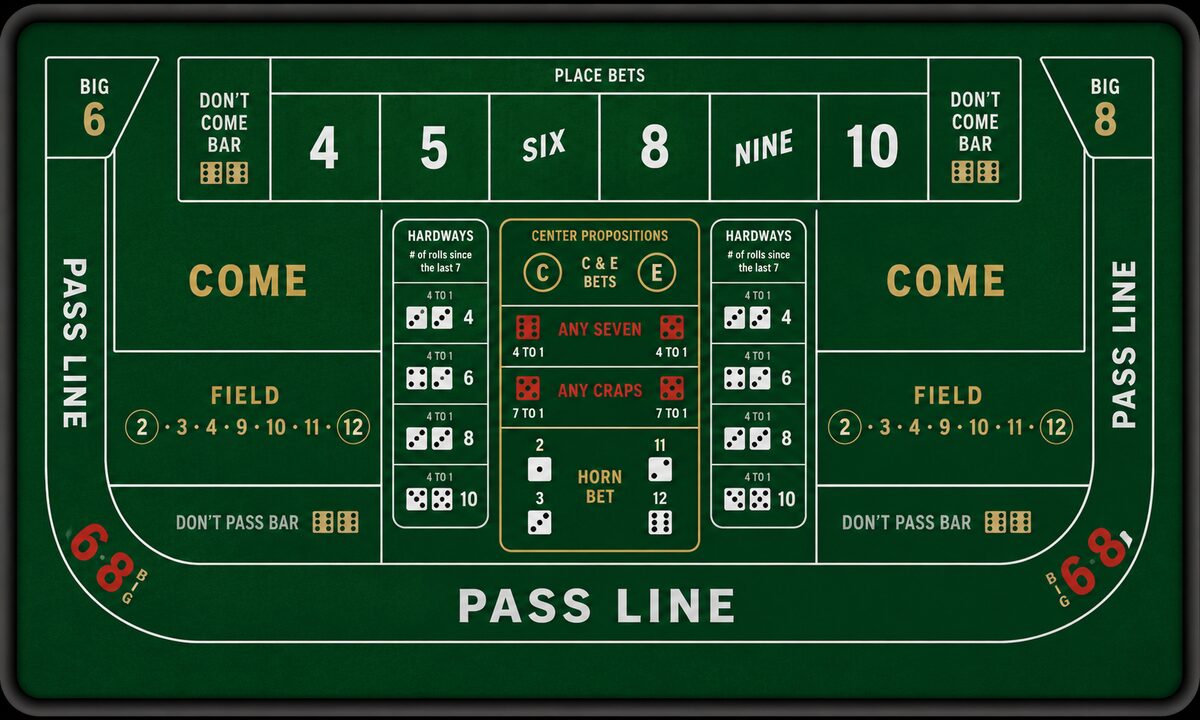
Pass Line covers six numbers; Don’t Pass covers five.
The craps table can look intimidating at first glance, but once you understand its geography, you’ll see that most of the felt is designed to separate good bets from expensive ones. The layout is mirrored on both ends, meaning two dealers can serve players on either side while a stickman manages the center.
Along the outer edge runs the Pass Line—a long strip where the most fundamental bet in craps is placed. Just above it sits the Don’t Pass Bar, for players betting against the shooter. The Come and Don’t Come boxes sit nearby, used for bets made after a point is established. In the upper section, you’ll find numbered boxes for 4, 5, 6, 8, 9, and 10—these are where Place bets live. The Field stretches across the bottom, covering 2, 3, 4, 9, 10, 11, and 12 for one-roll wagers.
Then there’s the center. This is where the casino makes serious money: Hardways, Horn bets, Any 7, and various proposition wagers with house edges ranging from 9% to over 16%. The stickman will happily take your action here, but experienced players know to stay away.
Where to stand and how to bet:
New players should position themselves at the table ends or along the right side for easy dealer access. Place your Pass Line chips directly on the line before the come out roll. For Odds bets, the dealer will help you position chips behind your Pass Line wager. Place bets are called out verbally—“Place the six for twelve dollars”—and the dealer handles placement.
The bets this article focuses on:
- Pass Line and Don’t Pass (the foundational line bets)
- Come and Don’t Come (mid-round entries with the same edge)
- Odds bets (the only 0% house edge wager in the casino)
- Place 6 and 8 (low-edge bets on the most frequently rolled numbers)
Most named betting systems are built from combinations of these wagers. The center propositions—while exciting—aren’t part of any legitimate long-term craps strategy.
Pass Line Bet
The Pass Line bet is where nearly every craps player should start. It’s simple, it’s visible, and it carries one of the lowest house edges in the entire casino at about 1.41%.
Here’s how it works: before the come out roll, you place your chips on the Pass Line. If the shooter rolls a 7 or 11, you win immediately at even money (1:1). If they roll 2, 3, or 12, you lose immediately. Any other number (4, 5, 6, 8, 9, or 10) becomes the point.
Once a point is established, your pass line bet stays in place. You’re now rooting for the shooter to roll that point number again before rolling a 7. If the point hits first, you win even money. If a 7 appears first, you lose. This is the natural rhythm of craps, and the pass line bet follows it perfectly.
Example: You bet $10 on the Pass Line. The shooter rolls an 8, establishing the point. Over the next several rolls, the shooter throws 5, 6, 11, and then 8. Your Pass Line bet wins $10. You now have $20 in front of you—your original bet plus profit. You can rack that win or press slightly for the next come out roll.
The 1.41% house edge means that for every $100 you wager on the Pass Line (resolved bets), you can expect to lose about $1.41 on average. That’s dramatically better than slot machines, roulette, or most table games. This is why virtually every basic craps strategy starts here rather than jumping to Place bets or center wagers.
Don’t Pass Bet
The Don’t Pass bet is the mirror image of the Pass Line. Instead of betting with the shooter, you’re betting that they’ll fail to make their point. It’s sometimes called “wrong way” or “dark side” betting.
On the come-out roll:
- Rolling 2 or 3: You win (3/36 probability)
- Rolling 7 or 11: You lose (8/36 probability)
- Rolling 12: Push—your bet is returned (1/36 probability)
- Rolling 4, 5, 6, 8, 9, or 10: A point is established, and you’re now hoping for a 7 before that point
The push on 12 (called “barring the 12”) is what protects the casino. Without it, Don’t Pass would actually have a player advantage on the come out roll.
Once a point is set, the math shifts in your favor. Since 7 appears more frequently than any single point number (6/36 compared to 3/36 for 4 or 10, 4/36 for 5 or 9, and 5/36 for 6 or 8), you have better odds of winning your Don’t Pass bet after the point is established. The overall house edge on Don’t Pass is about 1.36%—slightly better than the Pass Line.
The catch? Social friction. At a crowded live craps table, you’ll be winning when everyone else loses. During hot rolls when the table erupts in cheers, you’ll be watching your bets get swept away. Some players actively dislike “wrong way” bettors, though most experienced craps players understand it’s a valid mathematical choice.
This pressure disappears entirely in online casinos or on bubble craps machines, where nobody knows or cares which side you’re playing. For beginners at live tables, starting with Pass Line is usually more comfortable, but learning Don’t Pass conceptually gives you strategic flexibility.
Come and Don’t Come Bets
Think of Come bets as a new Pass Line that starts in the middle of a round. After a point is already established, you can place chips in the Come area, and the next roll becomes your personal come out roll.
How Come bets work:
- If the next roll is 7 or 11: Your Come bet wins immediately
- If the next roll is 2, 3, or 12: Your Come bet loses immediately
- If any other number is rolled: Your Come bet travels to that number box, and it wins if that number is rolled before a 7
Don’t Come works identically to Don’t Pass but starts mid-round. Your Don’t Come bet moves behind a number and wins if 7 appears before that number hits.
Example of a 2-point situation:
You have $10 on the Pass Line with the point at 6. You place $10 in the Come area. The shooter rolls 8. Your Come bet moves to the 8 box. Now you have two bets working: $10 on the Pass Line (point 6) and $10 on the 8.
If the shooter rolls 6, your Pass Line wins but your Come bet on 8 stays active. If the shooter rolls 8, your Come bet wins but your Pass Line stays active. If the shooter rolls 7, both bets lose.
This spreading of risk across multiple points is the foundation of strategies like the 3 point molly discussed later. Come bets and Don’t Come bets carry the same house edge as their line equivalents (about 1.4%), making them core ingredients in any structured approach. Adding Odds behind each of your Come bets further reduces your overall cost.
Why Craps Strategy Matters: Odds, Payouts, and House Edge
H× odds at Sahara cuts Pass Line edge to 0.18%.
Here’s the fundamental truth about playing craps: no betting system can change the randomness of the dice. Each roll is independent. The dice have no memory of what happened before. Two standard six-sided dice produce 36 possible combinations, and those probabilities are fixed by physics, not by your betting patterns.
What you can control is which bets you make. And this is where strategy actually matters.
The difference between true odds and payout odds is where the casino makes its money. True odds reflect the actual mathematical probability of an outcome. Payout odds are what the casino actually pays you when you win. The gap between these two numbers is the house edge.
House edge comparison for common craps bets:
| Bet Type | House Edge |
|---|---|
| Pass Line / Don’t Pass | ~1.4% |
| Come / Don’t Come | ~1.4% |
| Odds (behind line bets) | 0% |
| Place 6 or 8 | 1.52% |
| Place 5 or 9 | 4% |
| Place 4 or 10 | 6.67% |
| Field (standard) | 5.56% |
| Hardways (Hard 6/8) | ~9.09% |
| Hardways (Hard 4/10) | ~11.11% |
| Any 7 | 16.67% |
These percentages tell you exactly what each bet costs over time. On 1,000 resolved $10 bets:
- At 1.4% edge: Expected loss of about $140
- At 5% edge: Expected loss of about $500
- At 10% edge: Expected loss of about $1,000
A sound craps strategy is mostly about limiting your average cost per roll, not trying to force wins from specific short sequences. You can’t control whether the dice land on 7 or 8, but you can absolutely control whether your money is riding on a 1.4% edge bet or a 16% edge trap.
Free Odds Bets: The Only 0% House Edge Wager
This is the most important concept in craps betting: Odds bets pay true mathematical odds with zero house edge. They are the only wager in the entire casino where the house has no built-in advantage.
After a point is established, you can place an Odds bet behind your Pass Line, Don’t Pass, Come, or Don’t Come wager. This bet pays exactly what probability dictates:
True odds payouts:
- Point of 4 or 10: Pays 2:1 (three ways to make it, six ways to make 7)
- Point of 5 or 9: Pays 3:2
- Point of 6 or 8: Pays 6:5 (five ways to make it, six ways to make 7)
The catch is that Odds bets must be attached to an existing line bet. You can’t walk up and bet Odds alone—you need that Pass Line or Come bet as your “qualifier.” This is why casinos allow them: they know not all players maximize their Odds, and the line bet still generates edge.
Typical Odds limits in 2024-2026:
- Vegas Strip casinos: 3-4-5x Odds is standard
- Off-Strip and regional casinos: Some offer 10x or even 100x Odds
- Online casinos: Varies widely, often 10x or higher
Concrete example:
You bet $15 on the Pass Line. The point is 6. At a 3-4-5x table, you can bet up to $75 in Odds (5 × $15). If the 6 hits:
- Pass Line pays: $15 (even money)
- Odds pay: $90 (6:5 on $75)
- Total profit: $105
Notice that $90 of your $105 profit came from the Odds bet—the portion with zero house edge. The casino only profited from the $15 line bet.
Every serious craps strategy should recommend taking as much in Odds as your bankroll and table rules reasonably allow. This is where you make your money work hardest.
Basic Craps Strategies for Beginners
Place 6 and Place 8 each pay 7:6 — best non-odds bets.
This section is your toolbox of simple, low-variance systems designed for new players at $5-$15 tables, both in physical casinos and many online casinos in 2026. Each strategy uses only a handful of bets, prioritizes the lowest house edge options, and aims to stretch a modest bankroll for 1-3 hours of entertainment.
The goal isn’t to get rich—the goal is to play longer while losing less. These approaches assume buy-ins of $200-$500 and table minimums from $5 to $15, reflecting current US casino conditions. When minimums creep up during peak weekend hours, these strategies become even more important for preserving your stake.
One important principle: stick with one method for at least several shooters before judging whether it “works.” Craps is volatile. Short-term results tell you almost nothing about whether your strategy is sound. The math plays out over hundreds of rolls, not dozens.
Pass Line Plus Odds Strategy
This is the default beginner strategy and should be your starting point before experimenting with anything more complex.
Step-by-step execution:
- Bet the table minimum on the Pass Line every come out roll
- When a point is established, add maximum Odds behind your line bet
- If the point hits, collect your winnings and decide whether to rack them or repeat
- If you seven-out, accept the loss and bet Pass Line again for the next shooter
- Repeat until you hit your session win/loss limit
Bankroll guidelines:
For a $10 table, bring at least $400-$600 (40-60x the minimum). This covers the volatility of seven-outs, which happen on average every 8-9 rolls after a point is established. Even with a low edge, you’ll experience losing streaks that require cushion.
Handling hot shooters:
When a shooter hits multiple points in a row, you can optionally press your Pass Line by one unit after two consecutive wins. If you started at $10, move to $15, then $20. Keep Odds at maximum regardless of your line bet size.
Handling cold tables:
When shooters are sevening out quickly, stay disciplined. Keep your line bet at the minimum, still take full Odds, and resist the urge to chase losses by increasing wagers. The math doesn’t change based on recent results.
This approach works because it minimizes the money exposed to the house edge (your line bet) while maximizing money at zero edge (your Odds). It’s boring, it’s slow, and it’s exactly what smart craps players do.
Come Bet “3-Point” Style Strategy
Once you’re comfortable with Pass Line plus Odds, you can spread your action across multiple numbers using Come bets. This creates more frequent small wins when the shooter throws several box numbers before sevening out.
Simple 3-Point approach:
- Bet the minimum on Pass Line as usual
- After the point is established, make a Come bet
- When your Come bet moves to a number, back it with Odds
- Make one more Come bet and back it with Odds when it moves
- Stop adding new Come bets once you have three numbers working
Concrete example:
At a $10 table with 3x Odds:
- Pass Line point: 5 ($10 + $30 Odds = $40 at risk)
- Come bet moves to 6 ($10 + $30 Odds = $40 at risk)
- Come bet moves to 8 ($10 + $30 Odds = $40 at risk)
- Total exposure: $120 across three numbers
Now any roll of 5, 6, or 8 wins one of your bets while preserving the others. You’re covered on 15 out of 36 possible outcomes (excluding 7). When a number hits, you can either pocket the win or make a new Come bet to replace it.
When to stop adding bets:
After 2-3 numbers are established, stop. More Come bets means more exposure to a single seven-out. The 3 point molly works because it balances action with protection—you’re not so spread out that one bad roll wipes everything, but you’re active enough that most rolls give you something to cheer about.
This strategy carries roughly the same house edge as Pass Line alone (about 1.4% on the line bets, 0% on Odds) but with more action per roll and more frequent small wins.
Place 6 and 8 for Low-Risk Action
The numbers 6 and 8 are rolled more frequently than any other point numbers—each has five ways to appear out of 36 possible dice combinations. Place bets on 6 and 8 have a house edge of just 1.52%, making them the best place bets available.
Basic execution:
- After a point is established, tell the dealer “Place the six and eight for twelve dollars each” (or appropriate multiple)
- Collect $14 on each hit (7:6 payout on $12)
- After a few hits, consider pressing by one unit
- Take bets down when you’ve locked in a profit or before a new shooter
Example at a $15 table:
You place $18 on 6 and $18 on 8. Each hit pays $21 (7:6 on $18). After two hits, you’ve collected $42 in profit. You can now press one bet to $24 and pocket the difference, or take both bets down with profit locked.
Combining with Pass Line:
Many players use Pass Line plus Odds as their foundation, then add Place 6 and 8 for additional action on high-probability numbers. This creates a balanced approach: one bet on the line with maximum Odds, plus steady action on the two most frequently rolled point numbers.
This strategy is popular with players who want constant involvement on box numbers but don’t want the complexity or edge of full “across” betting (covering 4, 5, 6, 8, 9, and 10). The low 1.52% edge makes it one of the best bets on the table outside of line bets with Odds.
Intermediate and Advanced Craps Strategies
If you’re comfortable with basic bets and table flow, these approaches give you more ways to attack hot rolls and protect against long losing streaks. They require larger bankrolls, closer attention to bet tracking, and higher tolerance for variance.
These aren’t magic systems that beat the house. They’re structured methods for pressing wins and managing exposure—tools that experienced players use to shape their sessions. The underlying math remains the same; you’re just choosing how to distribute your risk.
Before using any of these with real money at a busy table, practice on low-stakes online platforms or bubble craps machines. Getting the mechanics wrong during a live session can cost you money and slow down the game for everyone.
Using the Odds Bet as a Core Growth Tool
The smartest way to scale up your craps action isn’t increasing your flat line bets—it’s gradually expanding your Odds wagers while keeping the base bet minimal.
Progressive Odds approach:
| Session Phase | Line Bet | Odds Bet | Total at Risk |
|---|---|---|---|
| Starting | $10 | $10 | $20 |
| After +2 units | $10 | $30 | $40 |
| After +4 units | $10 | $50 | $60 |
| After loss streak | Back to $10 | $10 | $20 |
Simple rules:
- Only increase Odds after a net profit of two units in a shooter’s hand
- Never increase Odds when you’re at a loss for the session
- Reset to minimum Odds after any losing streak
- Line bet stays constant regardless of Odds size
This works because you’re keeping maximum money on the zero-edge portion of your wager while minimizing exposure on the edge-carrying line bet. A $10 Pass with $50 Odds still only costs you edge on the $10—but your profit potential is five times higher than $10/$10.
Savvy craps players in 2026 treat line bets as “qualifiers” that get them access to Odds, which is where the real money-making happens. Your line bet is the admission ticket; Odds are the main attraction.
The Iron Cross and Its Variants
The iron cross is one of the most discussed craps systems, primarily because it feels like winning. The structure covers almost every number on the board, creating frequent small wins that make the session feel successful.
Basic Iron Cross setup:
- $10 on the Field
- $10 Place on 5
- $12 Place on 6
- $12 Place on 8
- Total at risk: $44
What happens on each roll:
| Roll | Result | Net Outcome |
|---|---|---|
| 2 | Field pays 2:1 | +$20 |
| 3, 4, 9, 10, 11 | Field pays 1:1 | +$10 |
| 12 | Field pays 2:1 or 3:1 | +$20 or +$30 |
| 5 | Place 5 pays | +$14 (minus $10 Field loss = +$4) |
| 6 | Place 6 pays | +$14 (minus $10 Field loss = +$4) |
| 8 | Place 8 pays | +$14 (minus $10 Field loss = +$4) |
| 7 | Everything loses | -$44 |
The iron cross strategy wins on 30 out of 36 possible rolls. That sounds amazing—until you realize that the 6 losing rolls (7s) cost you $44 each, while most winning rolls only pay $4-$20. The effective house edge runs about 3.5-4%, depending on Field payouts.
Cautious use recommendations:
- Run the Iron Cross only during clearly hot rolls (several box numbers without a 7)
- Set strict stop-loss rules: take down all bets after any single 7-out
- Lock in profit after a set number of wins (e.g., eight hits)
- Never chase losses by adding more to the Field or Place bets
Modern variations include dropping the 5 (reducing exposure) or pressing only 6 and 8 after a few hits. The iron cross feels good because of frequent small wins, but it’s not a low-edge strategy. Use it sparingly.
3-Point “Molly” Style Systems (Light and Dark)
The 3-point framework is the backbone of many named craps systems. It simply means having three numbers working simultaneously, all backed with Odds.
Light side version (betting with the shooter):
- Pass Line + maximum Odds on the point
- First Come bet moves to a number + Odds
- Second Come bet moves to a number + Odds
- Stop adding bets; let winners resolve
- Replace any winning bet with a new Come if desired
Dark side version (betting against the shooter):
- Don’t Pass + lay Odds against the point
- First Don’t Come moves behind a number + lay Odds
- Second Don’t Come moves behind a number + lay Odds
- Wait for 7-out to collect all three bets
The dark side version is designed for cold tables showing frequent point-seven-out patterns. Lay Odds pay true odds in reverse—you’re risking more to win less, but the probability is in your favor.
Sample bankroll requirements:
For a $15 table running light side with 3x Odds:
- Three line bets: $45
- Three Odds bets: $135
- Minimum exposure per shooter: $180
- Recommended session bankroll: $600-$800 to handle variance
Toggling between light and dark:
Some players switch between approaches based on table trends. If three shooters in a row seven-out within four rolls, they move to dark side. If a shooter hits multiple points, they move to light. This feels logical, but be careful—short streaks tell you nothing about future rolls. The dice don’t care what happened two minutes ago.
Many advanced named strategies in the craps community are simply nuanced tweaks of these three-point frameworks. Master this structure, and you’ll understand most systems people discuss online.
Craps Systems vs. Reality: What They Can and Cannot Do
Let’s be direct: no craps strategy—whether Martingale, ladder betting, the iron cross, or any complex hedging system—can turn a negative-edge game into a positive-expectation one. The math is fixed. The dice are random. Anyone claiming otherwise is either confused or trying to sell you something.
Progression systems are particularly misunderstood. The Martingale (doubling your bet after each loss) doesn’t change the house edge—it just changes when you win or lose. You’ll win more frequently (small amounts), but when you eventually lose, it’s catastrophic.
Example: Field Martingale at a $10 table
| Roll | Bet | Total Invested | Result |
|---|---|---|---|
| 1 | $10 | $10 | Lose (7) |
| 2 | $20 | $30 | Lose (7) |
| 3 | $40 | $70 | Lose (6) |
| 4 | $80 | $150 | Lose (8) |
| 5 | $160 | $310 | Win (4) |
| Net result | +$10 profit |
That looks fine—until you consider what happens when six losses occur in a row. At roll 6, you’d need to bet $320 to continue the progression, meaning $630 total invested for a potential $10 profit. Most tables cap bets at $500 or less, and most bankrolls can’t handle five consecutive $100+ bets. The system doesn’t fail because of bad luck; it fails because table limits and bankroll limits exist.
Psychological traps:
Human memory is selective. We remember the session when our aggressive pressing on 6 and 8 turned $100 into $400 during hot rolls. We forget the five sessions when those presses evaporated during quick seven-outs. Over time, the house edge grinds down even the most elaborate systems.
What “good craps strategy” actually means:
- Clear rules that you follow consistently
- Bets with modest house edge (under 2%)
- Bankroll protection through position sizing
- Predetermined win and loss limits
- The discipline to walk away when limits are hit
A legitimate craps strategy isn’t about guaranteed income—it’s about playing the game intelligently, extending your entertainment value, and giving yourself the best mathematical chance when luck does run your way. Craps is just a game. The house always has an edge. Accept that reality, and you can still have fun.
Bankroll Management and Session Planning

Stack chips by denomination — track session bankroll easily.
With table minimums at many US casinos running $10-$25 in 2026 (and higher during peak hours), bankroll planning matters as much as bet selection. You can know every craps bet inside-out and still go broke in an hour if you buy in short or chase losses.
Concrete bankroll guidelines:
| Strategy Type | Multiplier | $10 Table | $15 Table | $25 Table |
|---|---|---|---|---|
| Conservative (Pass + Odds only) | 40x | $400 | $600 | $1,000 |
| Moderate (3-point style) | 50x | $500 | $750 | $1,250 |
| Aggressive (pressing) | 60x+ | $600+ | $900+ | $1,500+ |
These numbers aren’t arbitrary. Seven-outs happen. Cold streaks happen. You need enough runway to survive variance and still have chips when a hot shooter finally emerges.
Sample session plan for a $10 table:
- Buy-in: $600
- Win goal: +$150 (lock it and consider leaving, or play with “house money”)
- Loss limit: -$200 (walk away, no exceptions)
- Per-shooter exposure cap: $50 maximum (roughly 5x the table minimum)
- Break schedule: Every 45-60 minutes, step away for 5-10 minutes
Non-negotiable rules:
- Never access ATM, debit, or credit at the table
- Never increase bet size to chase losses
- Never loan chips to friends during a session
- Stop playing when tired, frustrated, or intoxicated
Responsible casinos and online platforms provide tools like loss limits, cooling-off periods, and self-exclusion for players who need help. Use them if your craps sessions are causing financial stress.
Practical Money Management Tips at the Table
Beyond overall bankroll, moment-to-moment decisions at the table determine whether you walk away with profit or empty pockets.
Simple actionable rules:
- Rack half of any win over two units immediately
- Limit presses to once or twice per number, then collect
- Stop betting on a shooter after a pre-set number of rolls (e.g., 15 rolls without sevening out = lock in profits)
- Never bet money you’ve already designated for another purpose
Color-up to lock in profit:
Exchanging small chips for larger ones accomplishes two things: it reduces visual temptation (a single $100 chip feels more “real” than twenty $5 chips), and it forces you to make a conscious decision to break that chip before betting it. After a winning shooter, color up your profits and keep them separate from your playing stack.
Divide your chips visually:
Create two distinct stacks or rail positions: one for your original bankroll, one for winnings. This lets you see at a glance whether you’re risking principal or playing with house money. Many disciplined players set a rule: once the original stack is gone, session over—even if profits remain.
Cap maximum exposure per shooter:
New shooters are the most dangerous moment in craps. You don’t know their rhythm, luck, or longevity. Cap your total bets at 4-5 base units until a shooter proves they can hold the dice. Once they’ve hit two or three points, you can expand exposure.
Emotional management:
Tilt destroys bankrolls faster than bad bets. If you’re angry about a quick seven-out, take a walk. If you’re euphoric about a hot roll, take a walk. The best time to leave a craps table is when you’re up and feeling good—not when you’re desperately trying to recover losses. This is part of real-world craps strategy, not just math.
Table Etiquette, Live vs. Online Play, and 2026 Trends
Craps has its own culture and unwritten rules, especially at live tables. Knowing the etiquette helps you feel comfortable and keeps the game moving smoothly for everyone.
Standard live craps etiquette:
- Handle dice with one hand only—never two hands, never palming
- Toss dice to the back wall; dealers will call “no roll” if you don’t
- Wait for the puck to show “OFF” before buying in
- Place Pass Line chips directly on the line yourself; dealers handle Odds and Place bets
- Keep drinks and hands away from the playing area when dice are in motion
- Don’t shout “seven” while dice are out—it’s considered bad luck and will annoy everyone
- Tip dealers with bets (“Two-way hard eight”) rather than cash when possible
Live play vs. online and bubble craps:
The fundamental math is identical whether dice land on felt touched by human hands or generated by random number algorithms. What changes is the experience:
| Factor | Live Table | Online/Bubble |
|---|---|---|
| Social energy | High | Low |
| Etiquette pressure | Significant | None |
| Strategy notes | Awkward to use | Easy and discreet |
| Table minimums | Often $15-$25+ peak | Often $1-$5 available |
| Game speed | Variable (60-100 rolls/hr) | Faster (your pace) |
| Security verification | Walk-up or players club | Performing security verification through account login |
Many online casinos require security verification before allowing real-money play. This typically involves verification successful confirmation of identity documents—a standard process for legitimate platforms. Don’t be alarmed by security service requirements; they protect both you and the casino from malicious bots and fraud.
2026 trends:
- Higher peak minimums on Vegas Strip push value seekers to mornings, weekdays, and off-Strip properties
- Some regional casinos still offer 10x or even 100x Odds—worth seeking out
- Digital craps with provably fair RNGs continues growing, especially for players who want low stakes and practice time
- New side bets like “All Tall Small” appear on layouts but carry high edges (10%+)
The permanent pillars:
Regardless of new side bets, higher minimums, or digital innovations, the fundamentals of effective craps strategy remain unchanged: understand the odds, use low-edge bets, take maximum Odds behind line wagers, and manage your bankroll with discipline.
The shooter rolls the dice. The dice land where probability takes them. Whether the respond ray id on your screen confirms an online session or a stickman slides you chips across felt, the math doesn’t change.
Practice your chosen strategies on low-limit or free-play platforms before risking real money in a busy weekend casino. Learn the flow of come bets working across multiple points. Get comfortable with when to press and when to rack. Understand how quickly a bankroll can disappear when you stray from line bets into high-edge territory.
Craps is exciting precisely because anything can happen on any given roll—a natural on the come out roll, a long string of hot rolls that makes everyone at the table richer, or a cold session where shooters seem allergic to the point number. You can’t control any of that. What you can control is which bets you make and how much you risk.
The right strategy won’t guarantee you win money every session. Nothing can do that. But a disciplined approach using Pass Line, Come bets, maximum Odds, and Place 6 and 8 gives you the best odds the game offers. Combined with smart bankroll management and the wisdom to walk away at the right time, that’s everything a craps player can reasonably ask for.
Now you know what experienced players know. The rest is up to the dice.