BetSoft Red Dog closed the studio’s 2013 RNG table push with a 3D Slots3 adaptation of the classic Acey-Deucey card game — and we frame it as the year’s spread-bet finale, layering a 97.249% RTP on a mechanic modern catalogues rarely ship.
The single-hand RNG table drops from BetSoft’s 2013 table-game programme, runs an 8-deck shoe for a 2.751% house edge, and exposes the EV-positive raise zone at spread 7+ that turns a passive ante game into a real strategy puzzle — with a free demo widely available on BetSoft-licensed operators.
How BetSoft Red Dog Works
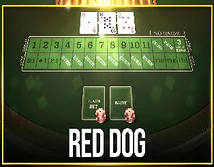
BetSoft built Red Dog inside the same Slots3 3D table wrapper used for Craps and Baccarat — green-cloth layout, click-to-deal pacing, no live dealer or multi-seat. The game runs solo: us versus the shoe, one round at a time.
Cards are valued strictly by rank — Ace at 14 down to deuce at 2. Suits are decorative and never affect the outcome. Joker cards are stripped from the 8-deck shoe, leaving 416 cards total per cycle.
The flow opens with an ante. The dealer turns two face-up “end cards” and the spread between their ranks decides what happens next — push, pair-trigger, or spread-with-raise.
Spread, Raise & Paytable
Three outcomes branch from the two end cards. Consecutive ranks (say 7 and 8) push immediately and we get our ante back. A pair (6-6) triggers a third card — match the pair and the payout is 11:1, miss and the round pushes.
A spread — any other gap — announces the betting window. We can Raise up to our ante before the third card lands, then watch whether the rank falls strictly between the two end cards.
| Spread | Payout |
|---|---|
| 1-card spread | 5 to 1 |
| 2-card spread | 4 to 1 |
| 3-card spread | 2 to 1 |
| 4-11 card spread | 1 to 1 (even) |
| Pair match (third card) | 11 to 1 |
The narrow spreads reward heavily because the win odds are small — only 7.7% of cards land in a 1-card spread. Wider spreads pay less but hit more often, with the 11-card spread winning 85.2% of rounds.
RTP & House Edge Math
BetSoft loads the shoe with 8 decks, which is the deck count that minimises the house edge across the Red Dog family. The result is a 2.751% edge and a 97.249% RTP — comfortably above modern industry average of 96%.
The math anomaly worth flagging is that more decks in Red Dog mean a smaller house edge, which inverts the blackjack rule of thumb. A single-deck Red Dog runs a 3.155% edge; the 8-deck variant we get from BetSoft drops that to 2.751%.
That positions BetSoft Red Dog among the highest-RTP RNG card tables we benchmark, comparable to European Roulette single-zero at 97.30% and well above American Roulette’s 94.74%.
When to Raise — The EV Ladder
Red Dog rewards a single binary decision: Raise or hold. Wizard of Odds expected-value modelling makes the answer mechanical — Raise only when the spread is 7 or wider, hold on everything narrower.
At spread 7 the Raise edge flips positive at +0.08 EV. Spread 8 climbs to +0.24, spread 9 to +0.39, spread 10 to +0.55, and spread 11 maxes out at +0.70 EV per unit raised — the most lopsided raise opportunity in mainstream casino card games.
Spreads 1 through 6 are net-negative when raised — narrow-spread payouts cannot offset the low hit rate inside the gap. We treat them as ante-only rounds and pocket the variance.
Naming History — Red Dog = Acey-Deucey = Yablon
Red Dog is the casino brand name for a card-game family with at least six regional aliases: Acey-Deucey (US gambling halls), Yablon (Slavic-origin), In-Between (home games), Sheets or Between the Sheets, Maverick (UK), and Scottish Foghorn (Scotland).
Wikipedia traces the rule core back to Russian-imported saloon games of the 1930s, with Britannica describing two distinct variants — the casino spread-bet version and a high-card-pool home variant. Bicycle Cards documents the In-Between home variant with looser rules.
Our review covers the BetSoft casino-spread variant only — the one with the spread paytable above, not the home In-Between version or the unrelated Red Dog Casino operator brand.
BetSoft’s 2013 Table-Game Programme
Red Dog closes BetSoft’s 2013 RNG table push on a card-game high note. The studio opened with European Roulette as the single-zero pioneer in March, shipped American Roulette two weeks later, followed with Craps as the dice-engine sister release in June, then Baccarat and Red Dog.
The 3D Slots3 wrapper that powered Genie’s Fortune slot in May 2013 carries directly into Red Dog’s table layout — same animation engine, same coin sizing logic, repurposed for spread-bet card mechanics. We treat the wrapper consistency as the architectural through-line.
One disambig note: this review covers BetSoft’s Red Dog table game, not the Red Dog Casino operator brand (separate Anjouan-licensed online casino) or any home-game Red Dog variant.
BetSoft Red Dog FAQs
What’s the RTP and house edge of BetSoft Red Dog?
How does the Red Dog spread paytable work?
When should we Raise in Red Dog?
Is Red Dog the same as Acey-Deucey or Yablon?
Where can we play BetSoft Red Dog’s free demo?
Final Verdict
BetSoft Red Dog is the 2013 RNG table that quietly preserved a fading card-game family inside a 3D wrapper. We recommend it for card-game purists who want a high-RTP spread mechanic over slot variance — and as a strategy puzzle where the spread-7+ raise zone turns ante play into a real edge.
The 97.249% RTP, 11:1 pair payout, and EV-positive raise ladder position Red Dog as a standout entry within our broader slots library — a card-game adaptation that still anchors BetSoft’s 2013 table programme closer.