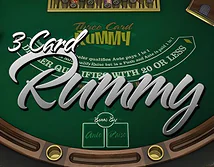
3 Card Rummy at BetSoft hands us the inverse of poker — three cards face up to the player, three face down to the dealer, and the smaller point total takes the pot. The wager structure is a single ante plus an optional bonus side bet, and the entire round resolves in one raise-or-fold decision.
Released August 2015 inside Betsoft’s catalog of table games, the single-deck duel runs on a 98.06% ante RTP, accepts $1-$100 wagers, and sits at the low-variance end of the studio’s casino lineup. We mapped the rules, the side bet math, and the one number governing both sides of the table.
How 3 Card Rummy Works at BetSoft
The deal is direct. After we place an ante and optional bonus side bet, the BetSoft client deals three cards face up to our side and three face down to the dealer. No drawing, no discarding — every hand resolves in one round.
Every card scores by pip value: aces count one, face cards count ten. The goal is to land below the dealer, so a six-point hand beats a dealer seven. Lower is better — the game inverts poker logic.
Three meld shapes drop a hand to zero: a pair, a three-of-a-kind, and a run of three cards in consecutive rank where at least two share the same suit. Unmelded cards stay live and add their full pip value back into the count.
The suited-run rule is where new players misread the felt. A 9♦ 8♣ 7♠ looks like a textbook run, but with three different suits the cards never meld — the sequence sits at twenty-four points of deadwood. Confirming suits before the raise is the cheapest discipline.
The Dealer Qualifying Rule and Raise Payouts
Before the dealer flips, we have one call to make: raise to match the ante or fold and lose it. We raise when the math sits with us and fold when the points climb too high.
If the dealer’s three-card total comes in at twenty points or fewer, the hand qualifies and our raise plays against it. If the dealer lands twenty-one or higher, the raise pushes and the ante pays even money.
When the dealer qualifies and we win, the raise pays on a sliding scale tied to our final point count:
| Player point total | Raise pays |
|---|---|
| 0 points (any meld) | 4 to 1 |
| 1 to 5 points | 2 to 1 |
| 6 or more points | 1 to 1 |
A clean zero-point meld therefore pays four to one on the raise plus another even-money on the ante — that combination is the table’s headline base-game return.
The Bonus Side Bet: Hands Below 12
Before any cards leave the deck, we can drop an optional bonus chip alongside the ante. This side bet is independent of the showdown — it pays even if we fold the main hand or lose to the dealer.
Payouts climb steeply for low totals and peak on a single hand pattern. The full bonus paytable looks like this:
| Bonus hand pattern | Bonus pays |
|---|---|
| Suited Ace-2-3 (special zero) | 100 to 1 |
| Other 0-point melds | 25 to 1 |
| 1 to 6 points | 2 to 1 |
| 7 to 10 points | 1 to 1 |
| 11 to 12 points | 4 to 1 |
| 13 or more points | Loss |
The Suited Ace-2-3 — three consecutive cards all sharing one suit, anchored by the lowest ace — pays one hundred to one. Most of the bonus’s house edge funds that single ceiling outcome.
The bonus carries a 3.46% house edge. That sits well above the ante’s 1.93% element of risk — the side bet is a variance lever, useful for short bursts but expensive over long sessions.
Optimal Strategy: The 20 Rule
Strategy here resolves to one number. The dealer needs twenty or fewer to qualify, and we need twenty or fewer to make the raise profitable — the rule above the table mirrors the rule below it.
We raise on any total of twenty or less and fold the rest. Above twenty, expected value drops below zero — we can only win when the dealer also fails to qualify, and even then the raise pushes.
The 9♦ 8♣ 7♠ deadwood example is the classic fold. Twenty-four points cannot beat a qualifying dealer, and the suited-run shortcut never closes. Saving the raise stake there compounds quickly across a session.
Across thousands of trials the average bet lands around 1.67 ante units because we raise roughly two thirds of hands. Element of risk lands at 1.93%, putting 3 Card Rummy below most roulette variants but above the strongest video poker titles.
RTP, Variance and Where to Play
BetSoft tunes 3 Card Rummy to a 98.06% ante RTP at optimal play with low documented volatility, a $1 minimum and a $100 ceiling. The release dates to August 2015 and uses a single shuffled 52-card deck per hand.
Set against the broader casino floor, the ante’s 1.93% element of risk slots below American roulette at 5.26%, under European roulette at 2.70%, and above full-pay Jacks or Better near 0.46%. The bonus side bet’s 3.46% lives in its own bracket.
For side-by-side house-edge comparisons see our full table games library before fixing on this title — Three Card Poker, Pai Gow and Ultimate Texas Hold’em sit close on the edge curve and trade off different decision points.
Demo Mode and Mobile Play
Most BetSoft-powered casinos publish the title with free demo hands mode loaded by default. We tested desktop and the HTML5 mobile build through 2026 — the felt rendered cleanly on both, and the legacy Flash dependency flagged in older reviews has been retired.
The interface keeps the chip stack, ante box, bonus box and raise control in one camera frame. Dealer voiceover narrates each outcome and the cards animate in casino-floor cadence on the wooden-felt table render.
Demo mode is the right place to internalise the suited-run rule and the twenty-point fold threshold before risking bankroll. Once the count instinct sets in, the same hand patterns drive real-money decisions.
3 Card Rummy FAQs
How do you play 3 Card Rummy by BetSoft?
What is a suited run in 3 Card Rummy?
When should you fold in 3 Card Rummy?
What is the RTP of 3 Card Rummy by BetSoft?
Can I play 3 Card Rummy free?
Final Verdict
3 Card Rummy suits low-edge bankroll-clearing play and table-game fans who prefer math-driven decisions over slot randomness. The base game’s 1.93% element of risk rewards disciplined folding; the bonus side bet stays an occasional variance dial. The demo is the cheapest classroom — twenty is the number that governs play, and the felt teaches it quickly.
When the appeal is a human dealer rather than tableau math, Evolution Baccarat Live, the studio’s flagship card table brings the same low-edge logic to a streamed bean-shaped table with a lobby of variants behind it.