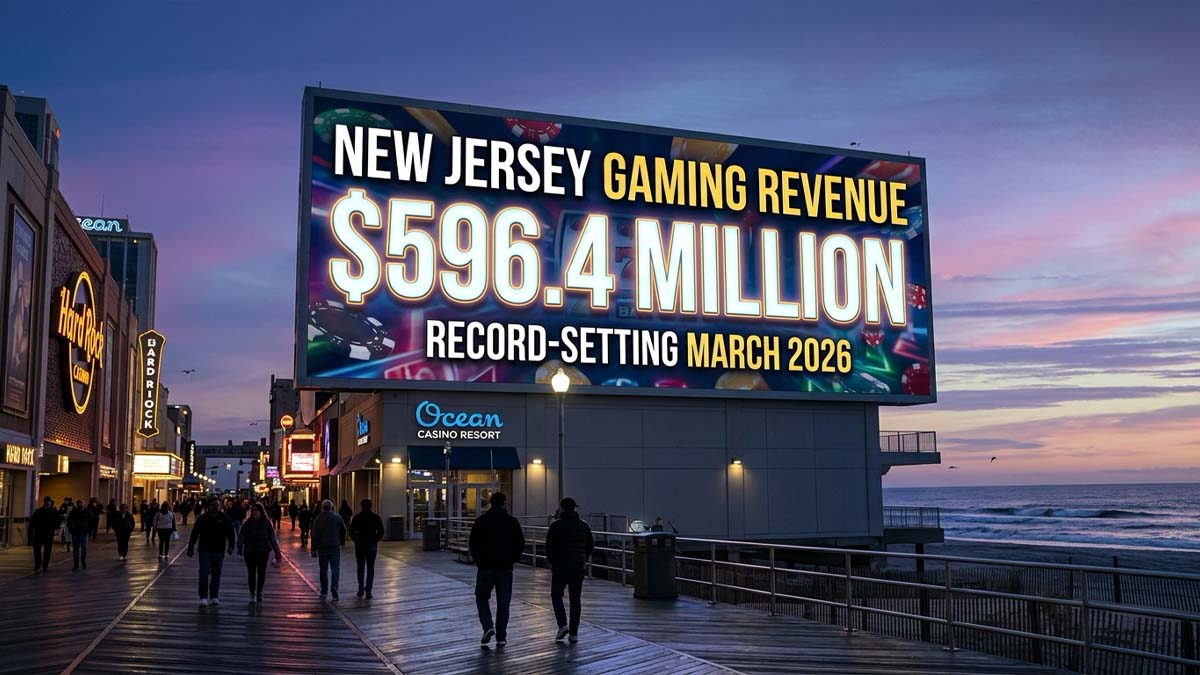
New Jersey Gaming Revenue Climbs to $596.4M in March as Online Play Dominates

New Jersey’s gaming industry continued its upward trajectory in March 2026, generating total revenue of $596.4 million, a 9.2% increase compared to the same month last year. The growth was largely driven by strong performances in internet gaming and sports betting, both of which outpaced traditional in-person casino revenue.
Data released by the state’s Division of Gaming Enforcement highlights an ongoing shift in consumer behavior, with digital channels now firmly established as the primary driver of market expansion.
Online Gaming Extends Lead Over Retail Casinos
Internet gaming once again emerged as the top-performing segment, producing $272.1 million in revenue for March, up 11.6% year over year. Notably, this marks the seventh consecutive month in which online gaming has surpassed revenue generated by Atlantic City’s nine brick-and-mortar casinos.
Retail casino revenue reached $236.6 million, reflecting a more modest 2.5% increase compared to March 2025. Despite trailing online performance, the figure represents the strongest March result for in-person gaming since 2013.
James Plousis, chairman of the New Jersey Casino Control Commission, pointed to the resilience of the retail sector while acknowledging the growing dominance of digital platforms. He noted that Atlantic City’s casinos continue to deliver solid results even as the broader market evolves.
He emphasized that the combined strength of all gaming segments has helped maintain consistent momentum, with total monthly revenue exceeding $500 million for 13 consecutive months, such as New Jersey’s gaming topping $520 million in February 2026. At the same time, he highlighted that internet gaming has reached one of its highest monthly totals on record, continuing a sustained period of growth.

Online casinos continue to become the major driver in New Jersey’s gaming revenue
Sports Betting Sees Strong Gains During Peak Season
Sports betting also delivered a standout performance in March, with operators reporting $87.6 million in revenue—an increase of nearly 23% compared to the previous year. The surge was supported by more than $1 billion in wagers, driven in part by seasonal events such as the NCAA March Madness.
The strong showing underscores the volatility and upside of the sports betting segment, which tends to benefit from major sporting events and high engagement periods. The March results echo projections outlined in betting on March Madness projected to reach $4 billion in 2026, underscoring the event’s importance to operator revenues.
For the first quarter of 2026, total gaming revenue in New Jersey reached $1.7 billion, representing a 7.5% increase year over year. The industry has also contributed significantly to state finances, generating $246.1 million in gambling taxes so far this year.
Industry analysts suggest that the combination of steady retail growth and accelerating digital adoption is creating a more balanced and resilient market structure.
Operators Show Mixed Performance Across Segments
Performance among individual casino operators varied in March, reflecting differing strategies and market positioning. Borgata Hotel Casino & Spa led the retail segment with $67.2 million in revenue, marking a 15.1% increase from the previous year. Ocean Casino Resort also posted gains, while several properties, including Hard Rock and Tropicana, reported slight declines.
In the online segment, leading platforms continued to drive growth. FanDuel generated $62.6 million in revenue, up 20%, while BetMGM reported $34.9 million, an increase of 10.4%. DraftKings, however, saw a slight decline of 2.6% over the same period.
The data reflects a competitive landscape where digital operators are rapidly scaling, even as traditional casinos maintain their role as a core component of the industry.
Jane Bokunewicz, director of the Lloyd D. Levenson Institute of Gaming, Hospitality and Tourism at Stockton University, pointed to seasonal factors influencing the performance gap between online and in-person gaming.
She explained that the continued dominance of internet gaming may be tied to weather patterns and convenience, noting:
The fact that brick-and-mortar gaming has not exceeded internet gaming since August 2025 may be indicative of a high degree of seasonality when it comes to in-person gaming.
Bokunewicz added that online platforms are likely to maintain their growth trajectory, particularly during colder months, while retail casinos could see stronger performance during peak tourism seasons.
A Market Defined by Digital Transformation
The March results reinforce a broader trend within New Jersey’s gaming industry: the steady shift toward digital-first engagement. While brick-and-mortar casinos remain a foundational element of the market, the convenience and accessibility of online gaming continue to attract a growing share of players.
Bokunewicz highlighted this dynamic, stating:
The convenience of gaming via online channels, especially when the weather is not at its best, is likely to continue resulting in growth for internet gaming operations, and flat brick-and-mortar performance in the shoulder and off seasons.