Michigan’s iGaming Market Exploded Beyond Expectations but Concerns Are Growing

Michigan’s online gambling industry has become one of the clearest examples of how rapidly regulated iGaming can reshape a state’s gaming economy.
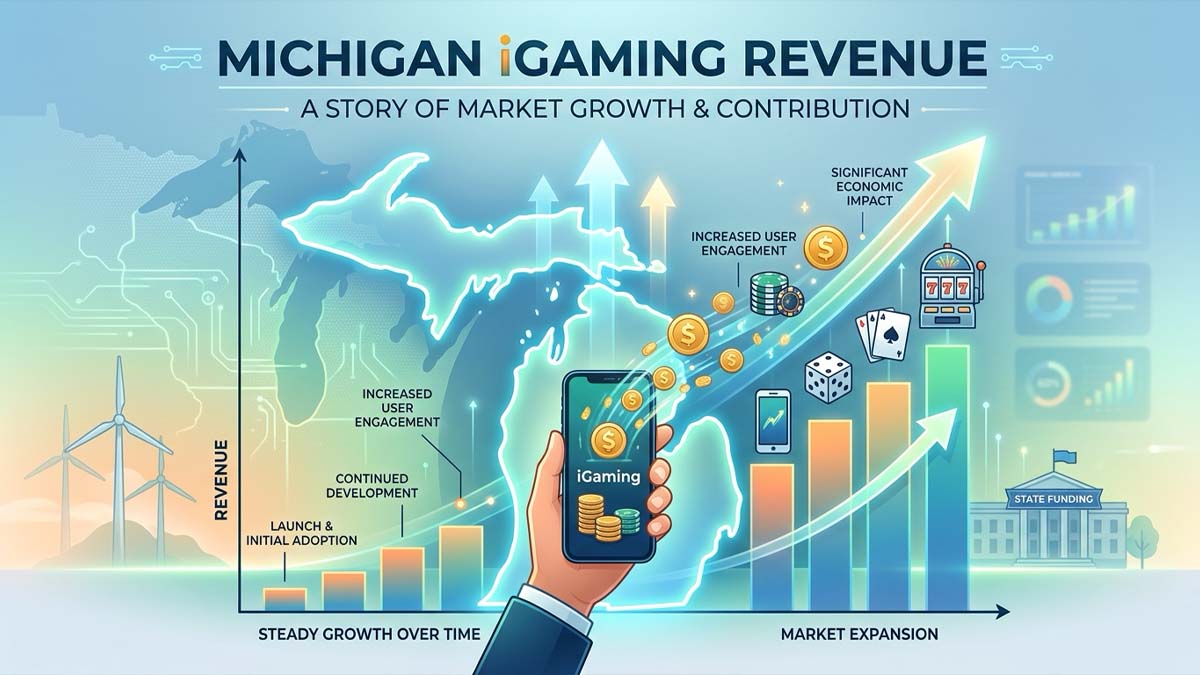
New figures show Michigan’s iGaming market generated over $3 billion in adjusted gross receipts during 2025, nearly ten times higher than the $300 million annual projection made by the state’s House Fiscal Agency in 2019 before legalization. Combined with online sports betting, Michigan’s digital gaming market reached $3.3 billion in adjusted gross receipts last year, marking a 39.5% increase over 2024.
The scale of the growth has positioned Michigan as one of the leading online gambling jurisdictions in the United States, rivaling established markets like New Jersey and Pennsylvania. However, the same reports driving optimism over tax revenue and market expansion are also highlighting rising concerns around problem gambling and player protections.
iGaming Continues to Outpace Sports Betting
Michigan officially launched online casino gaming and sports betting on January 22, 2021. Five years later, online casino products have become the primary financial engine of the state’s regulated gambling market.
Of the $3.3 billion generated in combined adjusted gross receipts during 2025, online casinos accounted for $2.9 billion, while sports betting contributed $435.9 million. The tax gap between the two verticals has become even more pronounced.
State tax revenue from iGaming reached $597.5 million in 2025, compared to just $27.1 million from online sports betting. The disparity has become increasingly important for lawmakers in states still debating whether to legalize online casino gaming.
Michigan’s growth has also continued into 2026. March set a new monthly record for iGaming gross receipts at $322.1 million, surpassing the previous record of $315.8 million established only three months earlier.
Nationally, online casino gaming generated a record $10.73 billion in revenue during 2025 across the seven states with legal iGaming markets. Pennsylvania led the country with $3.46 billion in revenue, while Michigan and New Jersey followed closely behind. In both Pennsylvania and New Jersey, online casino revenue exceeded land-based casino revenue for the first time last year.
Michigan appears to be approaching a similar milestone. State officials noted that taxes generated from iGaming already exceed the revenue collected from Detroit’s three commercial casinos.
Industry analysts point to Michigan’s balanced structure between Detroit commercial casinos and tribal operators as a major factor behind its success. The market currently features 15 licensed operators, including partnerships involving FanDuel, BetMGM, DraftKings, Caesars, Hard Rock Bet, and PokerStars.
Recent operator expansion has also intensified competition, particularly after bet365 entering the Michigan iGaming market following PokerStars’s exit.
Michigan’s iGaming revenue continues to outperform sports betting and land-based casinos
Concerns Over Cannibalization Have Not Materialized
One of the most common concerns surrounding online casino legalization has been the fear that digital gaming would cannibalize traditional casino revenue. Michigan’s data suggests the opposite may be happening.
According to state figures, aggregate revenue at Detroit’s three land-based casinos has remained relatively stable between 2021 and 2025, even as iGaming tax revenue surged from $201.7 million in the market’s first year to nearly $600 million in 2025.
Former state representative Brandt Iden, who helped lead Michigan’s 2019 legalization effort, argued that the market expanded instead of simply shifting existing players online.
National industry data appears to support that conclusion. The American Gaming Association reported that commercial land-based casino revenue increased 2.3% in 2025, while iGaming revenue climbed 27.6% during the same period.
The rapid growth has also been fueled by changing player behavior and technological improvements. Mobile gaming now accounts for the overwhelming majority of activity in Michigan, while live dealer products, micro-betting, and instant withdrawals have become major drivers of player engagement.
Operators have increasingly invested in personalized experiences, loyalty integrations, and Michigan-based live dealer studios as competition intensifies across the state’s crowded market.
Rising Self-Exclusion Numbers Raise Regulatory Questions
While Michigan’s financial performance has exceeded expectations, responsible gambling concerns are growing alongside the market.
When Michigan legalized online gambling in 2019, the state established a Responsible Gaming Database allowing individuals to voluntarily self-exclude from online gaming platforms.
The number of participants has risen sharply since launch. The database contained just 78 individuals at the end of 2021. By the end of 2025, enrollment had climbed to 1,644 participants.
The acceleration has drawn increasing attention from policymakers and addiction researchers. Michigan’s online self-exclusion growth rate significantly outpaces the state’s long-running Disassociated Persons List for retail casinos, which accumulated 4,252 participants over 24 years.
The Center for Addiction Science, Policy, and Research added to the scrutiny in March 2026 when it ranked Michigan 49th out of 52 U.S. states and territories for online gambling protections, issuing the state an “F” grade.
Critics cited limited safeguards against addiction and concerns over operators continuing to target high-risk users with advertising and promotions.
In response, Michigan officials have increased responsible gambling funding, while lawmakers introduced proposals aimed at restricting gambling advertisements and limiting targeted marketing toward younger audiences.
At the same time, the Michigan Gaming Control Board has intensified enforcement efforts against offshore gambling sites and sweepstakes operators, issuing more than 130 cease-and-desist letters as regulators attempt to protect the state’s licensed market.
Michigan’s iGaming industry has clearly become one of the country’s biggest regulatory and financial success stories. Whether the state can balance continued growth with stronger consumer protections may determine how other states approach online casino legalization in the years ahead.