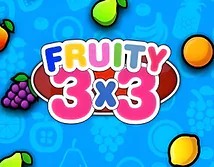
Jackpot 3×3 is 1X2 Gaming’s number-themed companion to its earlier Fruity 3×3 — same nine-cell grid, but each row runs its own paytable. The top row caps at 8× the line stake, the middle at 30×, and the bottom row carries the entire 500× apex on its own. RTP is 95%, volatility is medium, and the 9 paylines are independently toggleable — every cell is a mini-slot we can switch on, off, or batch into preset patterns. Coin values run $0.01 to $5 per line, so spin cost steps from a $0.10 floor to $45 at full coverage, with a roughly $2,500 cash ceiling that matches 1X2 Gaming’s €10,000 max-multiplier cap. No wilds, scatters, free spins, bonus round, or progressive jackpot.
How the 3×3 Grid Works
The cabinet renders as nine separate windows rather than one continuous reel set. Each window holds a single-cell payline that activates and stakes independently, and 1X2 Gaming exposes “defined patterns” as a shortcut for common configurations — rows only, columns only, diagonals — so toggling eight lines costs one click instead of eight. Total spin cost equals line stake times the count of active lines; coverage shrinks linearly when we drop lines. Three matching numbers on an active line is the only winning event.
This is the same architecture NetEnt’s Mega Joker sits adjacent to in spirit if not in mechanics — both treat a 3-reel base as deliberate restraint rather than a stepping stone to features — except Jackpot 3×3 redistributes resolution math across nine independent cells instead of stacking a Supermeter layer on top. Because each cell resolves independently, three-of-a-kind across multiple lines stacks: landing the bottom-row “500” symbol on every active bottom-row line at the maximum coin value is what produces the headline ceiling.
The Three-Row Paytable
The genuine differentiator from every other 3×3-grid slot — including the studio’s own Fruity 3×3, where one symbol hierarchy spans every cell — is the per-row paytable. The top row uses symbols numbered 1 through 8, so three of a kind on a top-row line pays the line stake times the symbol value, with the row capped at an 8× hit. The middle row uses 1, 2, 3, 5, 10, 15, 20, and 30, capping at 30×. The bottom row uses 1, 2, 5, 10, 25, 50, 100, and 500 — the 500× apex lives only here.
That tiered design turns each row into its own volatility lane. The top row generates frequent low-value wins because half its symbol set pays single digits; the middle sits in mid-range territory; the bottom carries the entire premium ceiling. At the $5 maximum coin, three top-row 8s pay $40, three middle-row 30s pay $150, and three bottom-row 500s land the $2,500 cash cap that maps to the studio’s €10,000 multiplier. Chasing the apex means accepting that two of three rows are mathematically capped low — Jackpot 3×3 makes us pick which lane to over-resource rather than smearing one paytable across nine cells.
Theme and Design
Visual identity lives in the windowed grid itself — nine separate panels with coloured borders, each cell a mini-cabinet rather than one continuous reel set. Symbols are stylised numbered stickers and coins, not fruit or 7s, which is what most distinguishes the look from sister title Fruity 3×3 and the wider 1X2 cluster of 3×3 releases (Italia 3×3, Football 3×3, Rainbow 3×3, Xmas 3×3 share the architecture but swap symbol vocabulary). Landscape mode arranges the cabinet as a true 3×3 grid; Portrait stacks it into a 2×5 layout for phones held vertically. Background art uses muted greens and deep reds; there is no soundtrack.
Strategy Tips
Two decisions drive almost every session. First, activate all nine lines whenever the bankroll allows — single-line play removes eight of the nine independent resolutions, and the $2,500 ceiling only becomes reachable with the bottom-row line live. Second, scale coin value down before dropping line count: nine lines at the $0.01 floor stakes $0.09 a spin and preserves the per-row coverage the design is built around. The single-payline classic format that Playtech’s Crazy 7 embodies is the inverse trade-off — one line, one stake, one resolution. Jackpot 3×3 gives us nine of each at the cost of paytable concentration on the bottom row.
Our Verdict
Jackpot 3×3 earns its place in the classic slots category by doing one thing few uniform-grid 9-line classics attempt — distributing paytable ceilings across rows, giving players a row-level lever on volatility. The 95% canonical RTP is fair rather than elite; operator-deployed variants exist in the wild (BetFury runs a 97.55% configuration), so the lobby’s published return is worth checking before play. Absent wilds, scatters, free spins, and a bonus round read as a deliberate audience filter rather than an oversight — built for players who treat feature absence as a design thesis. The 3×3 cluster offers fruit-themed alternatives; the row-tiered math is unique to this title.