Are Slot Machines Rigged? The Honest Answer From Inside the Industry

How we verified this: Every payout figure in this article comes from published regulator data, primarily Nevada Gaming Control Board revenue reports, and from the certification standards used by independent test labs such as Gaming Laboratories International. No casino paid for or reviewed this article.
No. Slot machines at licensed casinos are not rigged. But that answer alone lets casinos off too easy. Every slot is programmed with a house edge, so the casino wins over time without cheating anyone on a single spin. Casinos do not need to rig their machines; the math already does the work, legally. This article covers how slots decide outcomes, how to check fairness for yourself, and the one type of machine where calling it rigged is fair.
In this article:
- Are slot machines rigged? The short answer
- How slot machines actually decide every spin
- The house edge and RTP: how casinos win without cheating
- Who keeps slot machines honest?
- Why casinos do not need to rig slot machines
- Are online slot machines rigged?
- Are gas station slot machines rigged?
- Why slot machines feel rigged (even when they are not)
- 6 slot machine myths, debunked
- How to protect yourself
- FAQ
Are Slot Machines Rigged? The Short Answer
Slot machines at licensed casinos are not rigged. Every machine on a regulated floor, and every certified online slot, runs on a random number generator that an independent lab has tested and a government regulator has approved. No employee picks winners, and no switch tightens a machine because you have been doing well.
There is a second half to that answer. Every slot carries a house edge, so across millions of spins the casino keeps a predictable cut. The honest framing is yes and no. No, the games are not fixed against you on any spin. Yes, the long-term odds favor the house, openly and by design.
Rigged means cheating. House edge means math you can look up.
Secretly paying less than the advertised odds would be rigging, and it is a crime. Paying back roughly 96 cents per dollar over the long run while disclosing it in the paytable is not rigging. It is the business model.
How Slot Machines Actually Decide Every Spin
Every modern slot runs on a random number generator, or RNG, a program producing thousands of number combinations per second. The number active at the exact millisecond you press spin decides your result.
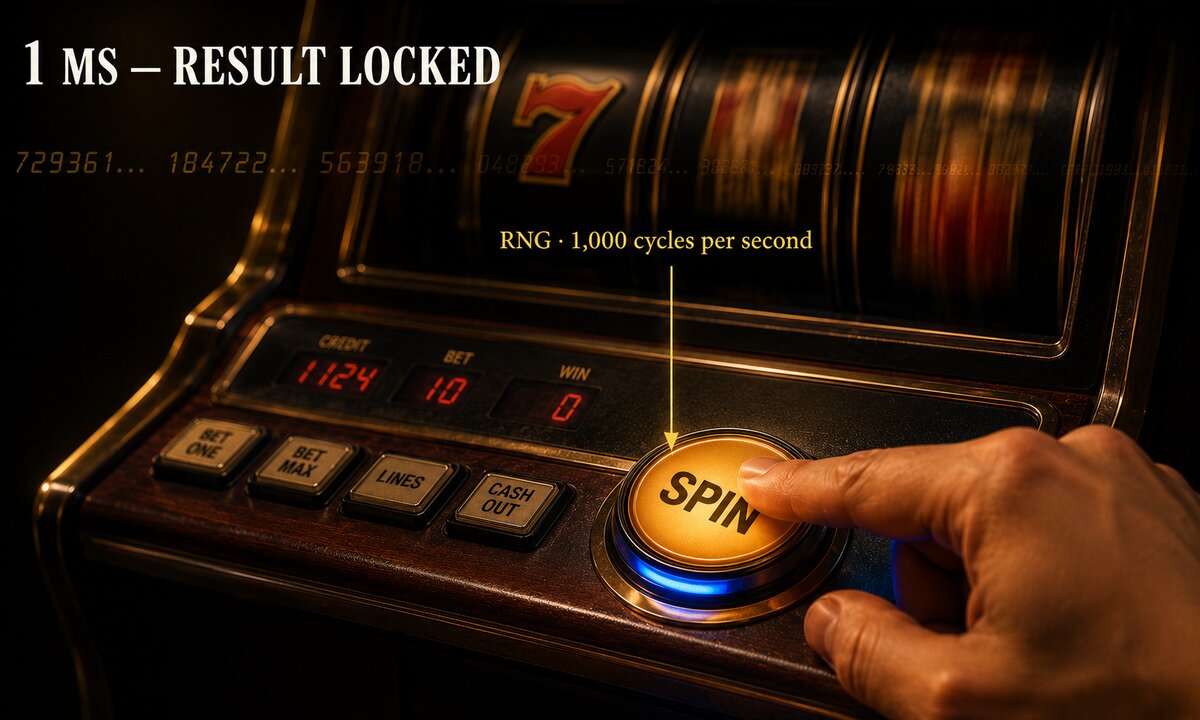
RNG cycles 1,000 numbers per second.
The RNG Never Stops Working
The RNG cycles constantly, even while the machine sits idle. When you hit the button, the game grabs whatever number the generator is holding at that instant and maps it to reel positions. The spinning reels you watch afterward are theater, an animation displaying an outcome that was locked in before they started moving.
This is the detail most explanations skip: because the result is decided at the button press, stopping the reels early changes nothing. You see your fate faster. You do not change it.
Why Past Spins Don’t Matter
Each spin is an independent event. The machine has no memory of being hot or cold, no quota, and no concept of being due. A slot that just paid a jackpot can pay another on the very next spin. A machine that has eaten 300 spins without a bonus owes you nothing, which is uncomfortable but true.
The House Edge and RTP: How Casinos Win Without Cheating
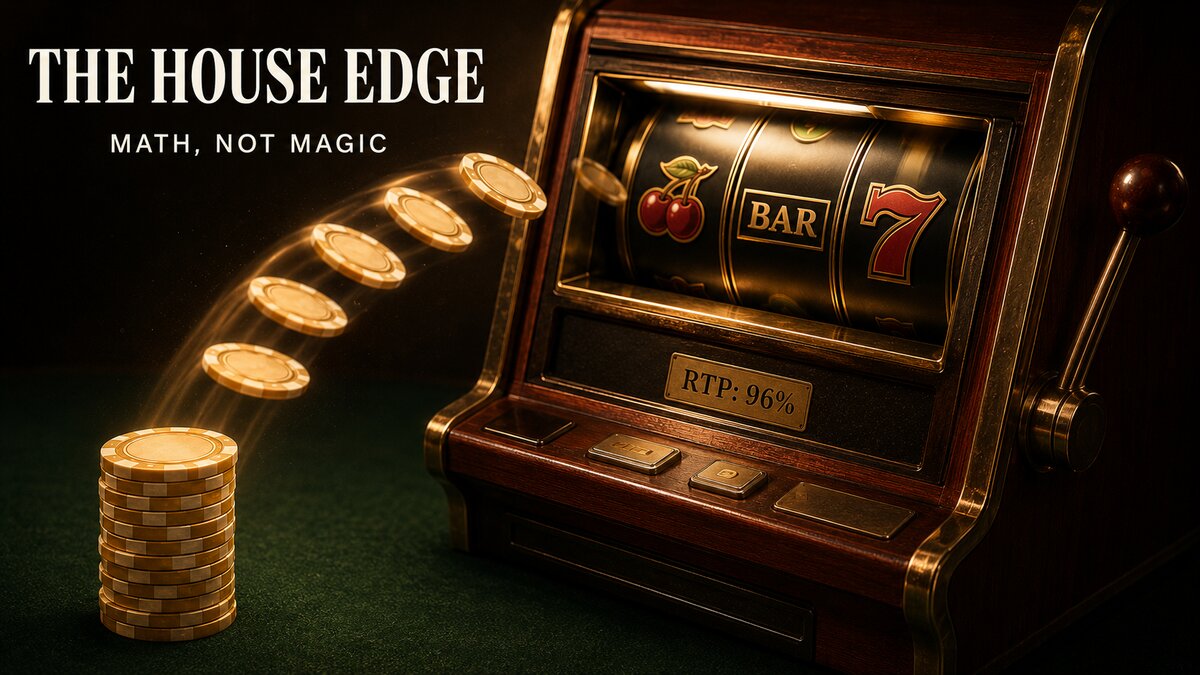
RTP stands for return to player, the percentage of all wagered money a slot pays back over its lifetime. A 96% RTP game returns about $96 for every $100 wagered, measured across millions of spins. The missing 4% is the house edge, the casino’s earnings without touching a single outcome.
Here is the caveat most casino sites bury: RTP is a long-run average, not a session promise. Over your 200 spins on a Saturday night, anything can happen. You can double your money on a 90% machine and lose your whole budget on a 98% one. The percentage only becomes reliable at a scale no individual player ever reaches.
Typical RTP by venue type:
| Where you play | Typical RTP | Notes |
|---|---|---|
| Las Vegas Strip casinos | 88% to 94% | Tourist-heavy floors run tighter, especially at low denominations |
| Regional and locals casinos | 90% to 94% | Often slightly looser to keep repeat customers |
| Licensed online slots | 94% to 97% | Lower overhead, RTP usually published per game |
| Gas station and route machines | Often unpublished | Frequently no legal minimum, no audits, no public reports |
Those few points are not cosmetic. A 92% RTP slot has an 8% house edge, double the 4% edge of a 96% game, so it burns your bankroll roughly twice as fast for the same bets. Denomination matters too: in Nevada, penny slots hold around 90% while $5 machines pay closer to 94.5%, a spread regulators report every month. If you want the best long-term numbers, it pays to know which titles rank among the highest RTP slot machines before you load a coin.
None of this is secret. The Nevada Gaming Control Board publishes monthly revenue reports breaking down slot hold by denomination and region, and New Jersey’s Division of Gaming Enforcement does the same for Atlantic City. Anyone with a browser can check whether casinos pay what the math says they should. They do, because the alternative ends careers.
Who Keeps Slot Machines Honest?
Three layers stand between you and a crooked machine: government regulators, independent test labs, and tamper-proofing on the casino floor. Rigging a slot at a licensed casino means beating all three, in writing, with logs.
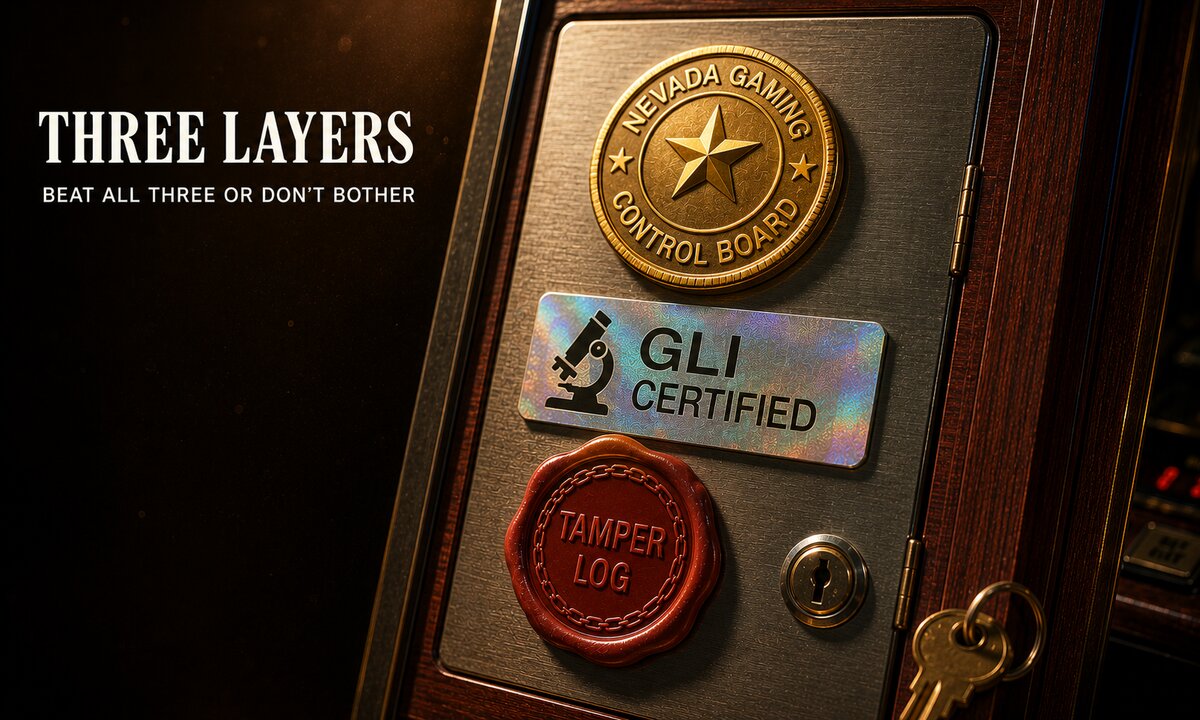
Three layers protect every licensed slot machine.
Government Regulators
These are not vague gambling authorities; they are named agencies with subpoena power. In the US, the Nevada Gaming Control Board and New Jersey’s Division of Gaming Enforcement set the standards most states copy. The UK Gambling Commission licenses every site legally serving British players, the Malta Gaming Authority covers much of the international online market, and in Canada, AGCO and iGaming Ontario regulate the provincial market. Each can pull a license, freeze operations and refer cases for prosecution.
Independent Test Labs
Before a slot reaches a floor or a website, an accredited lab certifies it. The big names are Gaming Laboratories International (GLI), eCOGRA, iTech Labs and BMM Testlabs. Certification is not a rubber stamp: labs review the game’s source code, run millions of simulated spins to confirm results match the claimed RTP, and re-audit after any update. A certified game’s math model is frozen, so the casino cannot quietly edit it later.
Tamper-Proofing on the Casino Floor
Physical machines get the same treatment. Game software ships on sealed, signature-verified media, and regulators can pull a chip at random and compare it against the approved version on file. Every RAM clear is logged. Changing a machine’s paytable requires filed paperwork and regulator sign-off, not a setting flipped on a Friday night. Surprise inspections happen, and revenue that drifts from the approved math triggers audits automatically.
When Rigging Actually Happened, and How It Ended
Rigging is rare, not impossible, and the documented cases are the best evidence the system works. In the late 1980s, the American Coin scandal became the largest organized cheating scheme in Nevada history when a route operator was caught programming its machines so the top jackpots could never hit. Regulators uncovered it and the company was dismantled.
Even insiders get caught. Ronald D. Harris was a Nevada Gaming Control Board engineer who hid code in slot chips so accomplices could trigger jackpots. A suspiciously perfect keno win in Atlantic City exposed him in 1995; he was convicted and banned from every Nevada casino. The man who knew the system best could not beat it quietly.
Why Casinos Don’t Need to Rig Slot Machines
Casinos do not rig slots for the same reason banks do not counterfeit currency: the legal version of the business already prints money, and the illegal version destroys it.
- The math already guarantees profit. A 4% to 8% edge applied to millions of spins per month is an enormous, predictable income. Cheating could only add pennies to it.
- The penalty is existential. Getting caught means losing the gaming license, fines, likely prison, and a reputation that never recovers.
- Competition punishes tight floors. Players talk, and regulators publish the numbers. Even semi-isolated markets like Maine sit in the same 89% to 94% band as everywhere else, because a casino known for not paying empties out fast.
“A casino license is a license to print money. Nobody risks the printing press to steal a few extra dollars.”
Are Online Slot Machines Rigged?
Licensed online slots are not rigged, and they usually pay back more than land-based machines, typically 94% to 97% RTP. The fairness mechanics are the same: certified RNGs, lab testing, regulator oversight. Two extra safeguards apply online.
First, online RTP is usually published per game: open the info or paytable screen on almost any modern slot and the return percentage is printed right there. Second, the casino does not control the math at all. Studios like NetEnt, Pragmatic Play, IGT and Light & Wonder build the games and host them on their own servers, so the site you play at cannot reach in and adjust outcomes even if it wanted to. If you are newer to this side of gambling, it helps to understand how to play online slots before betting, since volatility and paylines shape your results far more than any conspiracy could.
Now the honest warning: rigged slots do exist, and they live almost exclusively on unlicensed offshore sites. Rogue operators have been caught running bootleg clones of popular games, fake versions of Starburst or Book of Dead with the artwork copied and the math gutted. The graphics look identical; the RTP is whatever the crooks set it to. This is why where you play matters more than what you play, and why testing titles through free demo slots from verified providers is a low-risk way to learn a game before money is involved.
How to Verify a Legit Online Casino
Five checks, two minutes, no expertise required:
- Find the license number in the site footer, then look it up on the regulator’s public register. UKGC, MGA and state regulators all have searchable databases.
- Look for a test lab seal (eCOGRA, iTech Labs, GLI) that clicks through to a live certificate, not a pasted logo.
- Open a game’s info screen and confirm the RTP is published.
- Check that the games come from recognized providers. Crooked sites rarely land real NetEnt or Pragmatic Play contracts.
- Read the withdrawal terms before depositing, and cross-check the operator against independent casino reviews rather than taking the homepage’s word for it.
Are Gas Station Slot Machines Rigged?
Not always in the criminal sense, but gas station slot machines are the closest thing to rigged slots most players will ever touch. These so-called skill games, sweepstakes machines and route machines in gas stations, bars and convenience stores mostly operate in a legal gray zone that casino slots left behind decades ago.
What is missing is everything this article has described so far. In many states these machines face no minimum RTP requirement, no lab certification, no regulator audits and no published payout reports. Some are not true RNG slots at all but pre-programmed pull-tab systems working through a finite pool of outcomes, meaning the machine can know exactly what is left to pay. The owner sets the payout percentage, nobody checks it, and you cannot look it up.
The honest verdict: a gas station machine is not necessarily cheating you, but it is unverified, unaccountable and almost always far worse value than a regulated casino slot. If the word rigged applies anywhere in the slot world, it applies here.
Class II vs Class III: A Quick Distinction Worth Knowing
Class III machines are the Vegas-style slots this article has covered: independent RNG, certified math, regulated odds. Class II machines, common at some tribal casinos, are technically electronic bingo. Your spin enters a shared bingo draw against other players, and the reels just display the result. Class II games are legal and regulated by tribal authorities, but the math works differently. Gas station machines are frequently neither class, which is exactly the problem.
Why Slot Machines Feel Rigged (Even When They’re Not)
Your instincts are not crazy. The experience of playing a slot is engineered. The outcomes are not, and knowing the difference explains almost every it-must-be-rigged moment you have ever had.
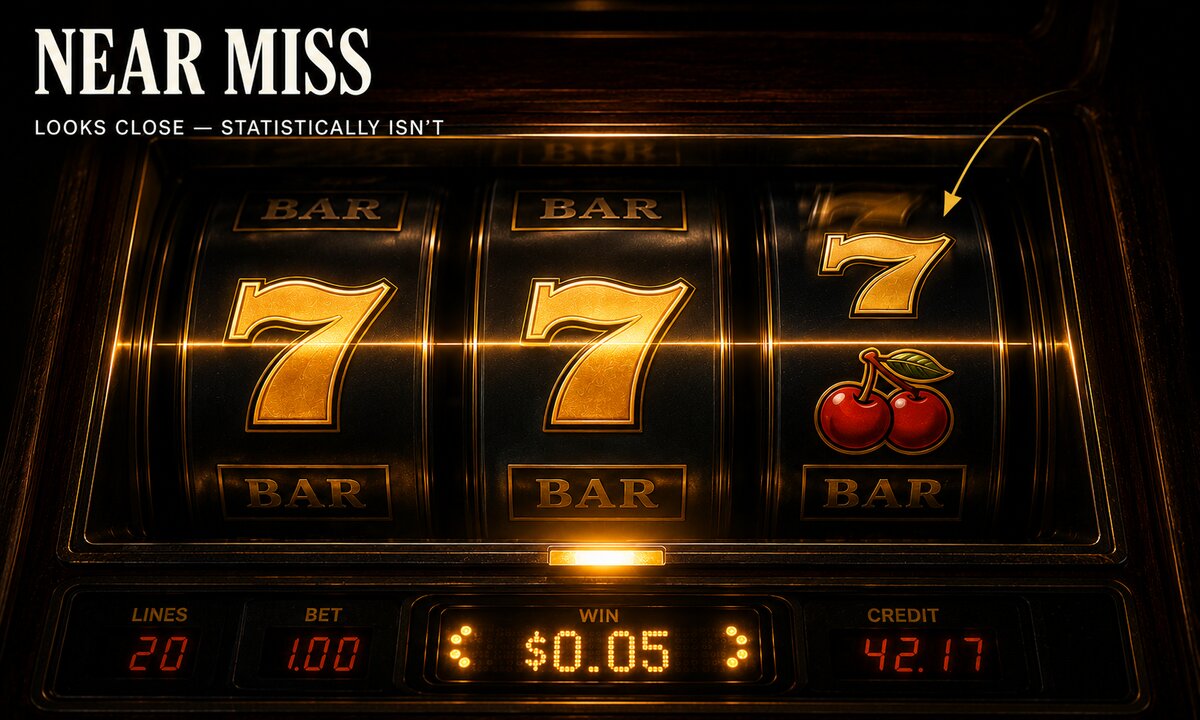
Near miss is statistically just another loss.
- Near misses. The jackpot symbol landing one position off the payline registers as almost won. Statistically it is identical to any other loss, but your brain treats each one as evidence you are close. Nevada considered this manipulative enough that deliberately programming false near-miss results has been illegal there since 1989.
- Losses disguised as wins. You bet $1, win back 10 cents, and the machine erupts in celebration. You just lost 90 cents to a light show. Multi-line slots produce these constantly, and they make losing sessions feel like winning ones.
- The gambler’s fallacy. After ten dead spins, it feels due. It is not. Independent events do not balance themselves out on your schedule.
- Loss aversion and selective memory. Losses sting roughly twice as hard as equivalent wins feel good, and you remember brutal cold streaks far better than quiet wins. Stack those biases and a perfectly fair machine starts to feel like a pickpocket.
Volatility: The Other Reason Slots Feel Cold
Volatility describes how a slot distributes its payback. A low-volatility game pays small amounts constantly. A high-volatility game can sit silent for 50 spins, then drop a win worth 500 bets, while running exactly the math on its certificate. Take a high-volatility slot into a short session with a small budget and the most likely outcome is a fast loss that feels rigged and is simply variance.
6 Slot Machine Myths, Debunked
| Myth | Fact |
|---|---|
| Machines near the entrance pay more | Modern floors run 1,000 to 4,000 machines ordered at uniform target RTPs. Placement is about foot traffic and sightlines, not payback. |
| Casinos flip a switch to tighten machines remotely | Changing a paytable requires regulator approval, an idle machine and a logged event. It is paperwork, not a dial in a back room. |
| Slots pay differently at night or on weekends | The RNG has no clock. More people win on Saturdays because more people play on Saturdays. |
| A machine that just hit won’t pay again | Every spin is independent. The odds right after a jackpot are identical to the odds on any other spin. |
| Your players card or bet size changes the odds | Card tracking calculates your comps, not your outcomes. The RNG cannot see whether a card is inserted. |
| Stopping the reels yourself changes the result | The outcome is locked the instant you press spin. Slamming the stop button only reveals it sooner. |
How to Protect Yourself: Play Slots You Can Verify
You cannot beat the house edge, but you can refuse to play anywhere the edge is hidden. That habit alone removes nearly all genuine rigging risk:
- Play licensed venues only, whether a regulated casino floor or one of the vetted best online casinos operating under a real gaming authority.
- Verify the license on the regulator’s public register before you deposit anywhere.
- Look up your state’s published RTP reports if you play land-based. The numbers are free and current.
- Check a game’s RTP in its info screen, and prefer 96% or higher online.
- Avoid unregulated gas station and skill machines, and unlicensed offshore sites.
- Treat slots as paid entertainment with a fixed budget, which is easier with basic bankroll management in place before the first spin.
A note on playing responsibly: every slot is built for the house to win over time, so only play with money you have already decided to spend. Set a limit before you start, never chase losses, and walk away when the budget is gone. If gambling has stopped feeling like entertainment, free and confidential help is available through the National Council on Problem Gambling at 1-800-GAMBLER in the US, or GamCare in the UK.
FAQ: Quick Answers About Slot Fairness
Are slot machines rigged in casinos?
Are casinos rigged?
Is roulette rigged?
Can casinos control slot machines remotely?
Do slot machines pay more at certain times?
What is a good RTP for a slot machine?
Is online gambling safe?
How do I know if a slot machine is fair?
The Bottom Line
So, are slot machines rigged? At licensed casinos, no, and the proof is public: certified RNGs, named regulators, published payout reports and a fraud history showing cheaters get caught even inside the system. But slots are not beatable either. The house edge wins over time, every time, and no machine owes anyone a payout.
The real dangers are the ones nobody audits: unregulated gas station machines, unlicensed offshore sites and playing without a budget. Verify the license, check the RTP, set your limit, and the only thing a slot can take from you is the entertainment money you brought for it.