Is Online Blackjack Rigged? A 2026 Guide to What’s Really Going On


You’ve been dealt a 20. The dealer shows a 6. Easy win, right? Then they flip a 5 and draw a 10. Blackjack pays the house. Again. If you’ve found yourself wondering whether online blackjack is rigged, you’re far from alone. Let’s break down what’s actually happening behind those virtual cards.
Quick answer: is online blackjack rigged?
Online blackjack at properly licensed and regulated online casinos is not rigged. These platforms use certified random number generators for software-based games and real-time video streams with physical cards for live dealer blackjack, ensuring outcomes are random and verifiable through independent testing.
That said, rigged blackjack games absolutely can exist—primarily on unlicensed or offshore sites operating without oversight. Where you play matters far more than the game itself.
Major regulators overseeing fair play in 2026 include:
- UK Gambling Commission (UKGC)
- Malta Gaming Authority (MGA)
- New Jersey Division of Gaming Enforcement (NJDGE)
- Ontario’s Alcohol and Gaming Commission (AGCO)
Here’s the thing many players miss: the casino already has a mathematical house edge in blackjack. With optimal play under standard rules, that edge sits around 0.4% to 0.5%. On $10 million in total bets, casinos expect roughly $50,000 in profit without any cheating whatsoever. They simply don’t need to rig the game.
The rest of this guide breaks down how online blackjack works, why it feels rigged when it isn’t, and how to verify you’re playing at a legit site.
Understanding online blackjack in 2026
Online blackjack is the digital version of the classic casino game of 21, playable on desktop browsers, mobile apps, and even VR interfaces worldwide. Global online gambling revenue exceeds $100 billion annually, with table games like blackjack comprising about 15-20% of that figure.
Two main formats dominate the market:
| Format | How It Works | Speed |
|---|---|---|
| RNG Blackjack | Software simulates shuffles and deals using algorithms | 200+ hands/hour |
| Live Dealer Blackjack | Streamed from studios with real dealers and cards | 60-80 hands/hour |
Live games operate from secure studios in Malta, Latvia (where Evolution Gaming processes over 1,000 tables daily), and New Jersey land-based casino integrations like BetMGM.
Players compete against the house under standard rules: hit to take cards, stand to hold, double down to double the bet for one card, split pairs into two hands. Games typically use 4-8 virtual decks.
Rule variations profoundly impact the house edge. For example:
- Dealer hits soft 17: adds 0.2% to house edge
- 6:5 blackjack payouts (vs. standard 3:2): adds 1.4%
- Double after split allowed: reduces edge by 0.1-0.15%
Reputable sites disclose these rules in game info panels, with RTPs for variants like Single Deck Blackjack reaching 99.62% under perfect basic strategy.
What exactly is online blackjack?
Online blackjack replicates the physical game’s objective—get closer to 21 than the dealer without busting—using either digital card graphics in RNG mode or live video feeds of real dealers in studios.
On your screen, you’ll typically see:
- Draggable betting chips ($0.10 to $10,000 denominations)
- Hit/Stand/Double/Split/Insurance buttons
- Side bet options like Perfect Pairs (11:1 payout, ~95% RTP) or 21+3 (~96.3% RTP)
- Clear table limits (e.g., $1-$100 for casual play, $25-$5,000 for high rollers)
In 2026, many online casinos offer hybrid lobbies blending RNG quick-play with live tables from providers like Evolution Gaming, Pragmatic Play Live, and Playtech. Infinite Blackjack, for instance, allows unlimited players to join the same table simultaneously.
A typical RNG hand flows like this: you bet $5, receive a 10 and 6 (16), dealer shows a 10. You hit, draw a 5 for 21. The dealer reveals 9-6 (15), hits to 23, busts. You win. The whole process takes a few seconds—which is part of why losing streaks feel so intense online.
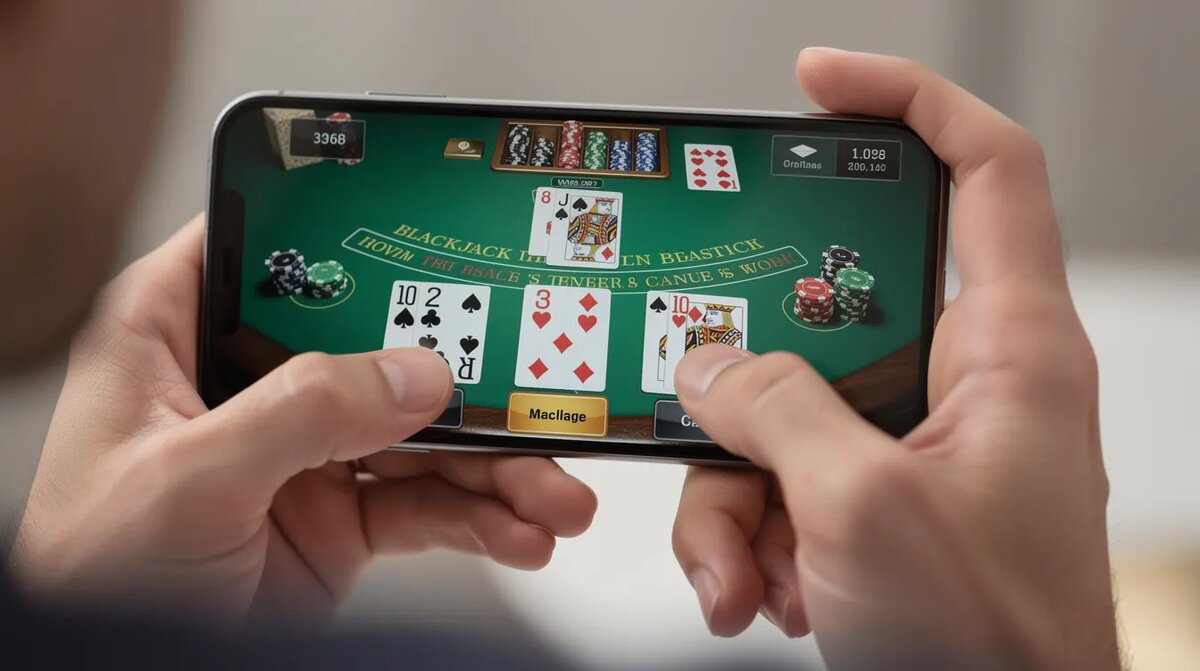
Card shoe penetration on RNG sites approaches 100%.
How online blackjack software works
RNG blackjack uses a Pseudo-Random Number Generator—a cryptographic algorithm like Mersenne Twister or Fortuna seeded by system entropy (hardware noise, user inputs). Each shuffle maps billions of numbers to a 52-card deck order.
The process works like this:
- RNG seed generates random values
- Hash function processes the values
- Array of numbers maps to card positions (e.g., 0-12 = ace through king per suit)
- Cards are dealt in sequence
- Each new draw pulls fresh RNG calls—previous hands influence nothing
Live dealer blackjack uses physical automatic shufflers handling 300 shuffles per hour, or pre-shuffled shoes inspected on camera. No digital RNG determines outcomes—the randomness comes from mechanical shuffling, verified by studio pit bosses.
Testing labs like eCOGRA, GLI, iTech Labs, and BMM Testlabs simulate 500 million+ hands to verify statistical fairness. They check that dealer blackjack frequency from an ace upcard hits around 4.75%, that card distribution matches chi-squared expectations, and that no predictable patterns emerge.
Why so many players think online blackjack is rigged
Repeated dealer 20s and 21s. Long losing streaks. Disconnects at the worst possible moment. These experiences feel deeply suspicious, especially when real money is on the line.
Feeling like a game is rigged is extremely common, even on fully fair platforms. The combination of human psychology and online play speed creates a perfect storm for suspicion.
Consider this: at 200 hands per hour online versus 60-80 in a physical casino, you’re experiencing variance at triple the rate. Statistically inevitable streaks that might take three hours in a real casino happen in under one hour online.
Forums document thousands of complaints. One player logged 319 rounds where the dealer blackjacked 12 times versus their 18. Sounds rigged, right? But that actually aligns with expected dealer win rates from an ace upcard (~31%).
Common “rigged” patterns players notice
The patterns that fuel suspicion tend to follow familiar themes:
- Dealer making 20 or 21 several hands in a row
- Player frequently receiving stiff hands (12-16)
- Long runs of small cards or high cards
- Dealer drawing exactly 5 when showing 16 (“miracle cards”)
- Losing 8+ hands consecutively
Here’s the math many players miss: in 1,000 hands at 200 per hour, you’ll likely see an 8-loss streak occur roughly 4 times. The probability of any single 8-loss streak is about 0.39% (assuming a 48% win rate), but across that many hands, it’s nearly guaranteed to happen.
When a dealer showing 16 draws to 21, it feels impossible. But that specific outcome—drawing exactly a 5—has roughly 23% odds depending on remaining cards. In 100 such situations, you’d expect it to happen 23 times. Players remember those 23 vividly and forget the 77 times the dealer busted.
How cognitive biases create the feeling of rigging
Several psychological factors amplify the perception of unfairness:
- Confirmation bias drives you to log “dealer miracles” while forgetting routine wins. Studies show gamblers recall losses 3x more readily than wins.
- Gambler’s fallacy makes you assume that after 10 losses, a win is “due.” When losses continue, it feels like evidence of cheating rather than random variance.
- Negativity bias means your brain weighs one bad $500 session more heavily than a week of $100 wins. The amygdala prioritizes threats.
Picture this: a player tracks 12 losing nights averaging -$200 each but omits their prior +$1,000 month. They perceive systemic bias despite breaking roughly even overall.
These biases are normal and powerful—especially with real money at stake. Recognizing them doesn’t make you immune, but it helps you wonder whether the game is unfair or your memory is selective.
The truth: how fair online blackjack actually is on regulated sites
In licensed jurisdictions, both RNG and live blackjack must meet strict fairness and transparency standards. Regulators require casinos and software providers to submit games for independent testing before approval and at regular intervals afterward.
Rigging a game would risk multi-million-dollar fines, license suspension, and public blacklisting. The UKGC has issued fines up to £5.3 million in recent cases. The MGA suspended 15 operators between 2022-2025 for RTP shortfalls. Real operators avoid these consequences.
The contrast between regulated platforms and offshore sites is stark. On reputable online casinos, every game undergoes security verification and regular auditing. On unregulated sites, anything goes.
RNGs and why they make rigging difficult on licensed platforms
Modern random number generators use AES-256 encryption with seeds refreshed per session. They must pass rigorous test batteries like Dieharder and TestU01 that verify true entropy.
What makes tampering detectable? If a rogue operator tried to boost dealer 21 frequency by even 1%, it would create skewed card distributions—reduced variance in low cards, anomalous patterns in card mapping. Labs running 10^9 (one billion) hand simulations catch these deviations.
Since around 2020, most regulators require RNG certifications to be dated and renewed annually. Public certification numbers (e.g., GLI-12345 for Evolution blackjack confirming 99.54% RTP) are visible on casino or lab sites.
When performing security verification on a blackjack game, labs check:
- Card distribution uniformity
- Absence of predictable sequences
- Chi-squared p-values >0.01 for randomness
- Cycle length exceeding 2^128 bits
Licensing and regulatory oversight
In markets like the UK, New Jersey, Ontario, and parts of the EU, online blackjack is only legal when offered by licensed operators. Here’s what major regulators require:
| Regulator | Key Requirements | Enforcement Examples |
|---|---|---|
| UKGC | Secure RNGs, 90-day dispute resolution, payout audits | £32M in fines 2020-2025 |
| NJDGE | GLI-certified RNGs, 85-98% RTP verification | 3 licenses revoked 2022-2024 |
| MGA | Quarterly fairness reports, player fund segregation | 200+ titles delisted 2023-2026 |
| AGCO | Real-time monitoring, 50+ licensed operators by 2026 | Mandatory fund ring-fencing |
Regulators can and do pull casino games or entire sites offline when audits or player complaints suggest unfair practices. Even with this oversight, you still need to verify a casino’s actual license by checking the license number on the regulator’s official website.
The built-in house edge: why casinos don’t need to cheat
Blackjack has a known house edge dependent on rules. Under favorable conditions with perfect basic strategy, it often runs 0.4%-0.8%. A common ruleset—8 decks, dealer stands on soft 17, double on any two cards, blackjack pays 3:2—yields approximately 0.43% edge.
But most real players don’t play perfectly. Strategy errors turn that edge into 1.5%-2% or more. Hitting 16 versus 10 suboptimally, chasing losses, ignoring the chart—these mistakes compound.
Here’s the long run math:
- 300 hands at $5 average bet = $1,500 wagered
- At 2% effective edge = $30 expected loss
- Scale across thousands of players = predictable, substantial profit
On $10 million in total bets with a 0.5% edge, casinos expect $50,000 profit. No cheating required. The math already favors the house, making any rigging attempt irrational for legitimate operators.
RNG audits run by eCOGRA, GLI, iTech Labs quarterly.
Can online blackjack be rigged on some sites?
While big, regulated brands almost never rig blackjack games, unlicensed sites absolutely can and sometimes do manipulate outcomes. This is where the “is blackjack rigged” question gets complicated.
Rogue operators might:
- Adjust game code to lower RTP by 5-10%
- Alter shuffling logic to favor dealer high cards after big bets
- Trigger disconnects during winning hands
- Void wins citing “technical glitches”
Players have reported suspicious patterns on offshore sites over the years. The challenge is distinguishing between bad luck and real manipulation—without access to back-end code, it’s nearly impossible to prove.
Your main defense is choosing only properly regulated casinos where independent testing occurs. If a site lacks visible licensing, consider your player funds at risk.
How blackjack software could be manipulated in theory
Imagine a rogue setup where the RNG is modified to slightly increase dealer 20-21 frequency in high-stake situations or immediately after big player wins. The algorithm prioritizes dealing 5-10 value cards to the dealer when the player has bet over $100.
Such tampering leaves statistical fingerprints. Over millions of hands, card distribution skews become detectable—reduced variance in low cards, anomalous chi-squared test results. Third-party testers would catch this if audits occurred.
The problem? Unregulated sites avoid external testing entirely. They can quietly change game parameters or payout tables at any time without anyone verifies the changes.
Manipulating single-player RNG blackjack is technically easier than rigging live blackjack, which is filmed and scrutinized by many players simultaneously. Any credible sign of manipulation—impossible card combinations, provably altered decks—should be widely discussed on forums and review sites.
Legal and financial risks for cheating casinos
Regulated operators face severe consequences if caught rigging live games or RNG software:
- License revocation (permanent market exclusion)
- Multi-million-dollar fines
- Criminal prosecution in some jurisdictions
- Permanent reputational damage
Over the 2010s and early 2020s, several operators were penalized for RTP inaccuracies or poor controls, demonstrating that enforcement is real and ongoing.
Losing access to major markets like the UK, EU, or US states would cost far more than any short-term rigging gain. The US iGaming market alone exceeds $50 billion. Getting banned from that for a 1% RTP manipulation on $1 million in bets—netting maybe $10,000 short-term—makes zero business sense.
Public, searchable records from regulators make it easy to see when operators have been disciplined, adding deterrence. For mainstream brands, the risk-reward calculation strongly discourages any cheating attempt.
How to tell if an online blackjack site is trustworthy
Before depositing money at any site, spend a few minutes checking licensing, software providers, and reviews. This security service you provide yourself is worth far more than chasing a signup bonus.
The following checklist helps separate safe online casinos from shady ones. This guidance applies in 2026, when many jurisdictions maintain clear online gambling registers accessible to the public.
Licensing, regulation, and audit seals
Scroll to the footer of any casino’s website. Look for licenses from:
- UKGC (UK Gambling Commission)
- MGA (Malta Gaming Authority)
- NJDGE (New Jersey Division of Gaming Enforcement)
- AGCO (Ontario)
- State-specific regulators (Michigan, Pennsylvania, West Virginia)
A real license listing includes a clickable license number leading to the regulator’s official site. If the link is dead or goes nowhere, that’s a major red flag.
Common testing lab seals include eCOGRA, GLI, iTech Labs, and BMM. Click through to verify they’re not just copied logos. Legitimate seals link to verification successful pages showing the specific games tested.
Avoid sites that:
- Provide no regulatory information
- Have fake or dead licensing links
- Claim vague “international” licenses with no legal address
- Display “First Cagayan” or similar dubious certifications
Some crypto-only casinos now provide “provably fair” systems using SHA-256 hashes, but blackjack implementations should still be backed by recognizable audits where possible.
Reputation, software providers, and game information
Check player forums, independent review sites, and recent social media posts for consistent payment or fairness complaints. A pattern of withdrawal delays or disputed wins across many players is a warning sign.
Blackjack games from well-known providers are generally safer:
- Evolution Gaming (market leader, 60% share, studios in 20+ countries)
- Pragmatic Play Live
- Playtech
- Microgaming/Light & Wonder
These providers face their own regulatory scrutiny and wouldn’t risk their reputation supplying rigged games.
Open a blackjack game’s info panel and confirm:
| What to Check | Good Sign | Sketchy Sign |
|---|---|---|
| RTP | ~99% listed clearly | No RTP shown or “varies” |
| Deck count | Stated (e.g., 8 decks) | “Proprietary” with no details |
| Blackjack payout | 3:2 | 6:5 or unlisted |
| Dealer rules | “Stands on soft 17” specified | Nothing mentioned |

Regulated sites hold ~99.5% RTP on basic strategy play.
Practical self-checks while you play
Track results over a reasonable sample—5,000 to 10,000 hands—before concluding a game is suspicious. Short-term swings are normal even on fair platforms.
Use basic strategy charts and stick to consistent bet sizing. This way, variance rather than poor play explains most losses. If you’re losing more than expected, check your decisions first.
Take note if the site:
- Frequently disconnects during big wins
- Resolves disputes always favoring the house without clear reasoning
- Delays withdrawals after winning sessions
- Changes rules mid-session without notice
Test the same rules on a well-regarded free blackjack simulator like Wizard of Odds (which publishes its RNG methodology) to compare your results. If your experience differs dramatically, that’s worth investigating.
Any serious suspicions should lead to stopping play immediately, attempting withdrawal, and reporting concerns to the regulator or broader community. Protect your money first, ask questions later.
FAQs: answering the most common “rigged blackjack” questions
Is online blackjack rigged or fair in 2026?
At licensed, regulated sites using certified RNGs or live dealers, online blackjack is fair. Outcomes are verified by independent testing labs on a regular basis. Rigged games primarily exist on unlicensed offshore sites operating without oversight.
What’s the difference between RNG blackjack and live dealer blackjack? Is one safer?
RNG blackjack uses software algorithms to deal cards, while live blackjack streams real dealers using physical cards from studios. Both are fair if certified and regulated. Live games offer more transparency since you can watch every card dealt via video, but RNG games from reputable providers undergo the same rigorous testing.
How can I know if a specific blackjack game is honest?
Check that the casino holds a valid license from a recognized regulator (UKGC, MGA, NJDGE, AGCO). Look for testing lab seals from eCOGRA, GLI, or iTech Labs. Open the game info panel—honest games display RTP around 99%, deck count, and clear rules. Games from Evolution Gaming or similar major providers carry additional credibility.
Why does the dealer seem to get 20 or 21 so often?
Dealers make strong hands frequently because the game’s structure favors completing hands to 17+. When showing a 10-value card, dealers have roughly a 35% chance of having blackjack or making 20. In a fast online session dealing 200+ hands, you’ll see many dealer 20s and 21s simply due to volume. It feels suspicious but aligns with probability.
Can I beat online blackjack in the long run?
No. Even with perfect basic strategy, the house edge (0.4%-0.8% under good rules) ensures the casino profits over time. You can minimize losses and enjoy extended play, but the math guarantees the house wins in the long run. Set strict loss limits and treat blackjack as entertainment, not income.
Conclusion: so, is online blackjack rigged?
Licensed, regulated online blackjack—both RNG and live games—is designed to be fair but mathematically favor the house. The same rules that apply in a physical casino apply online, verified through independent testing and regulatory oversight.
Rigged games are most likely to appear on unlicensed, offshore, or poorly reviewed sites with no audits. These operators face no consequences for manipulation and should be avoided entirely.
To play smart and protect yourself:
- Choose regulated casinos with verifiable licenses
- Check for eCOGRA, GLI, or similar audit seals
- Learn basic strategy to minimize the house edge
- Set strict loss limits before each session
Online blackjack can be an entertaining, fair game in 2026 if you approach it with appropriate skepticism toward shady operators and a clear understanding of how the house edge works. The question isn’t whether all online blackjack is rigged—it’s whether you’re playing at a site where rigging would be impossible to get away with.
Verify, play responsibly, and remember: unpredictable outcomes are a feature of fair games, not a bug.